via posthuman blues.
February 25, 2009
February 20, 2009
Taylor Baldwin
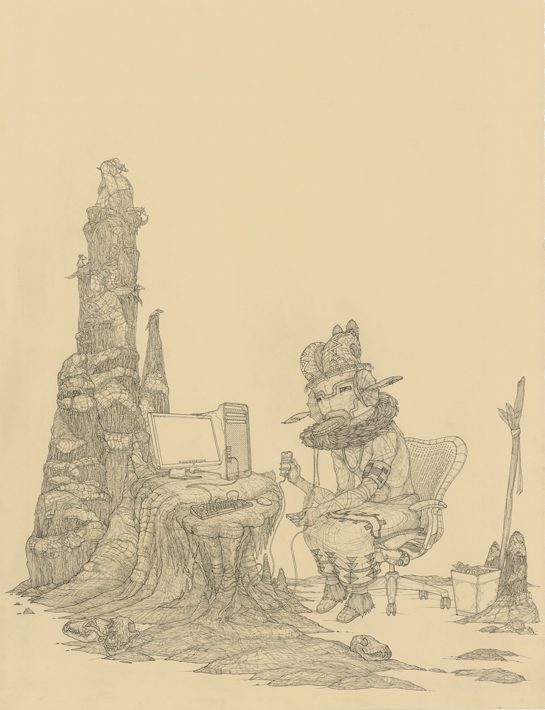
kachina performs upgrade ritual, cave salamanders look on
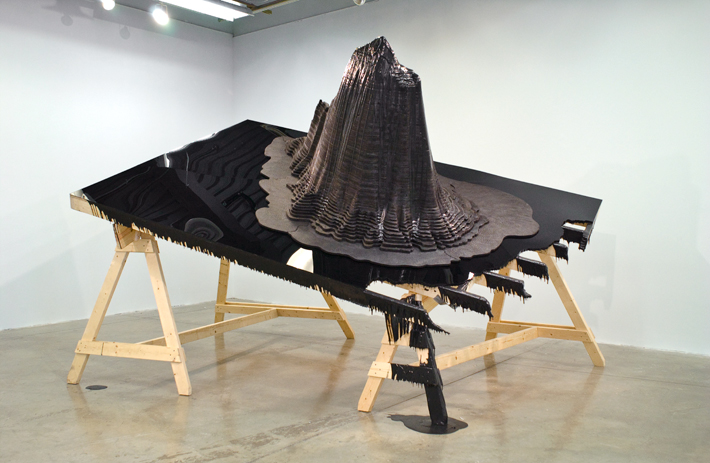
busted butte OR the evening deadness in the west
February 17, 2009
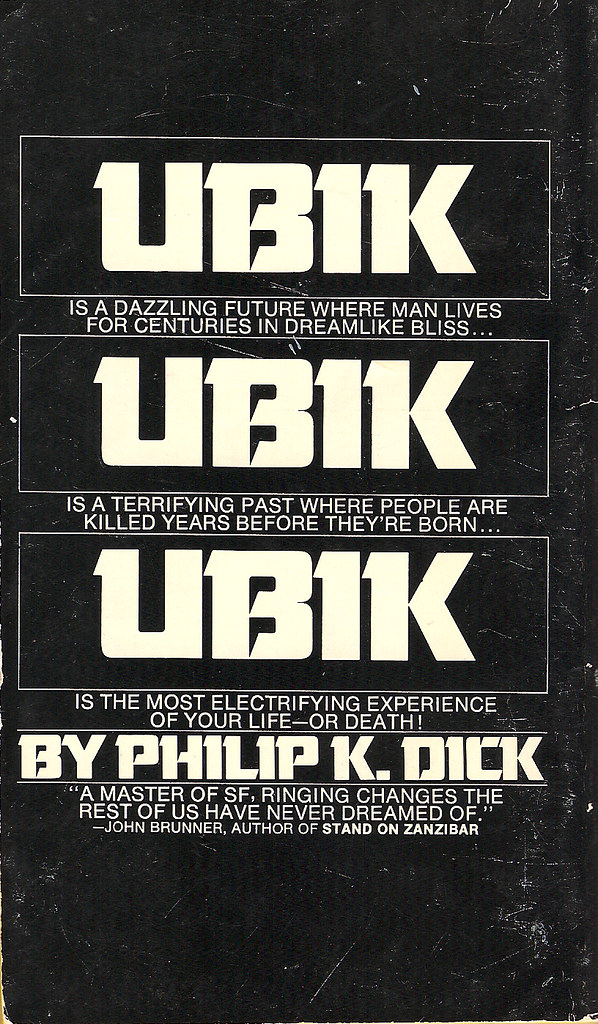
UBIK by PKD

I recently read the last nine tenths of UBIK by Philip K. Dick while laying in bed hungover, which only amplified the creepiness of its decaying, solipsistic world.

One thing I had never noticed before is how strange the clothing of future-1992 is. With so many things going on, its an easy thing to miss, but lets look at some passages:
“Beside [the chopper] stood a beetle-like individual wearing a Continental outfit: tweed toga, loafers, crimson sash and a purple airplane-propelled beanie.”
From Chapter Seven, Paragraph 52.
“… in gay pinstripe clown-style pajamas, Joe Chip hazily seated himself …”
From Chapter Three, Paragraph One.
Al Hammond was wearing “green felt knickers, gray golf socks, badger-hide open-midriff blouse and imitation patent-leather pumps…”
From Chapter Eight, Paragraph 43.
February 10, 2009
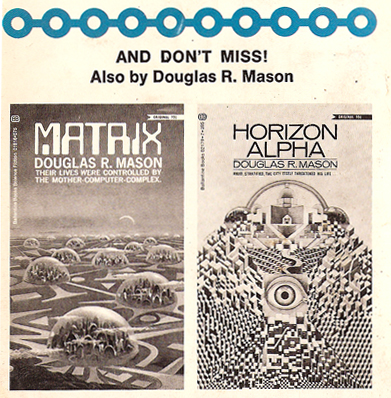
Dilation Effect and Horizon Alpha
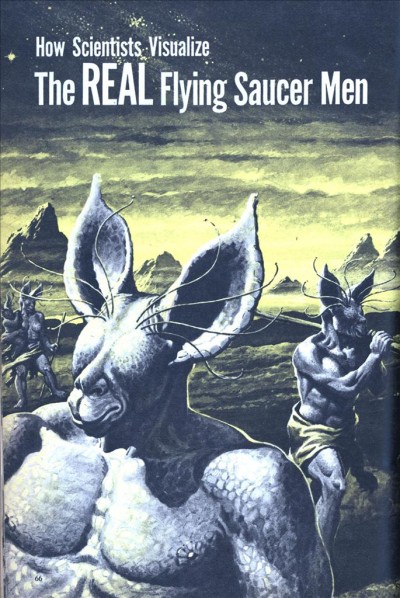
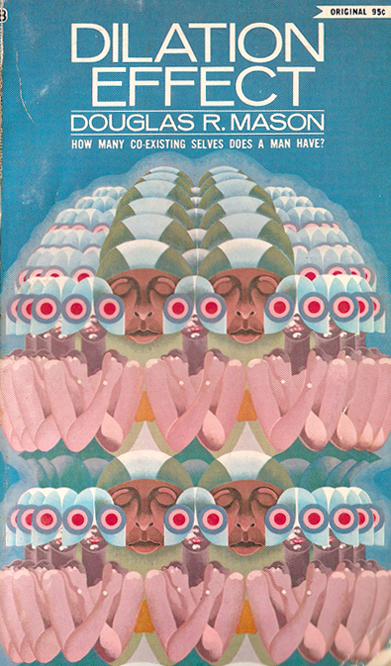
When I was in Houston I also went to Kaboom Books and picked up a whole stack of musty sci fi. Here’s the first sample:

I really wish that they had “Horizon Alpha”, but I couldn’t find it there and there aren’t any large images of the cover on the internet, unfortunately.

February 7, 2009
TRANZ
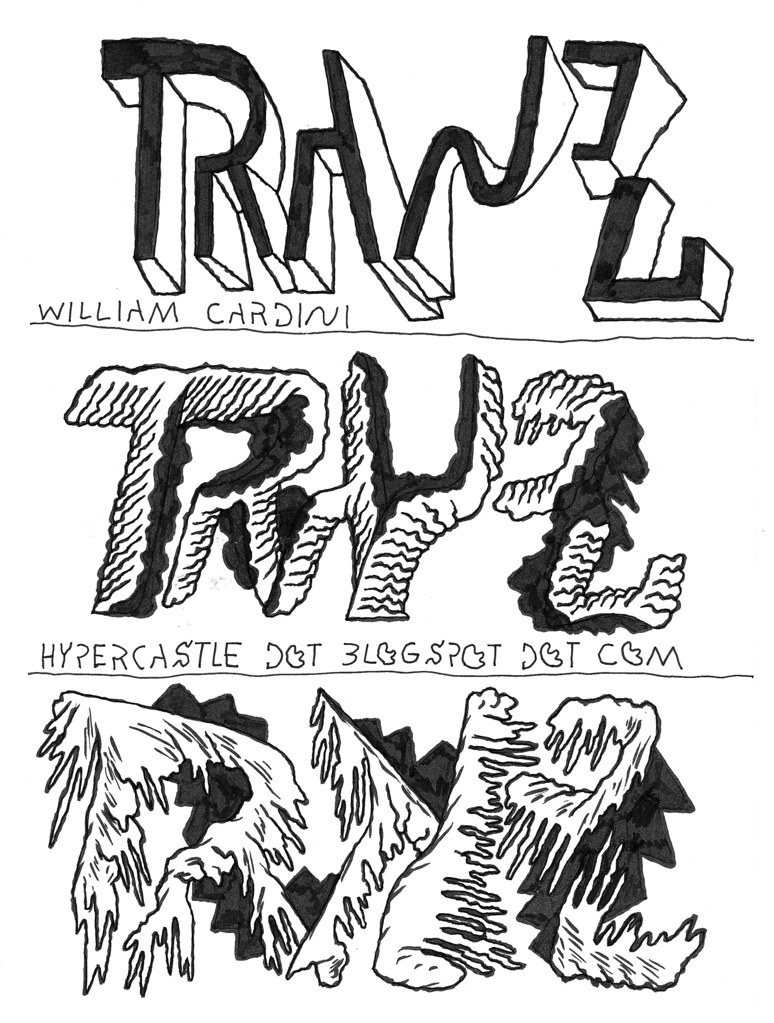
I’m working on a new comic called TRANZ that I plan on having ready for Staple 2009 (March 7th at the Monarch Event Center here in Austin). I started drawing it with Faber Castelli markers but now I’m going to do the whole thing in india ink with a 00 Windsor Sable Watercolor brush. Here’s the old version of the cover:
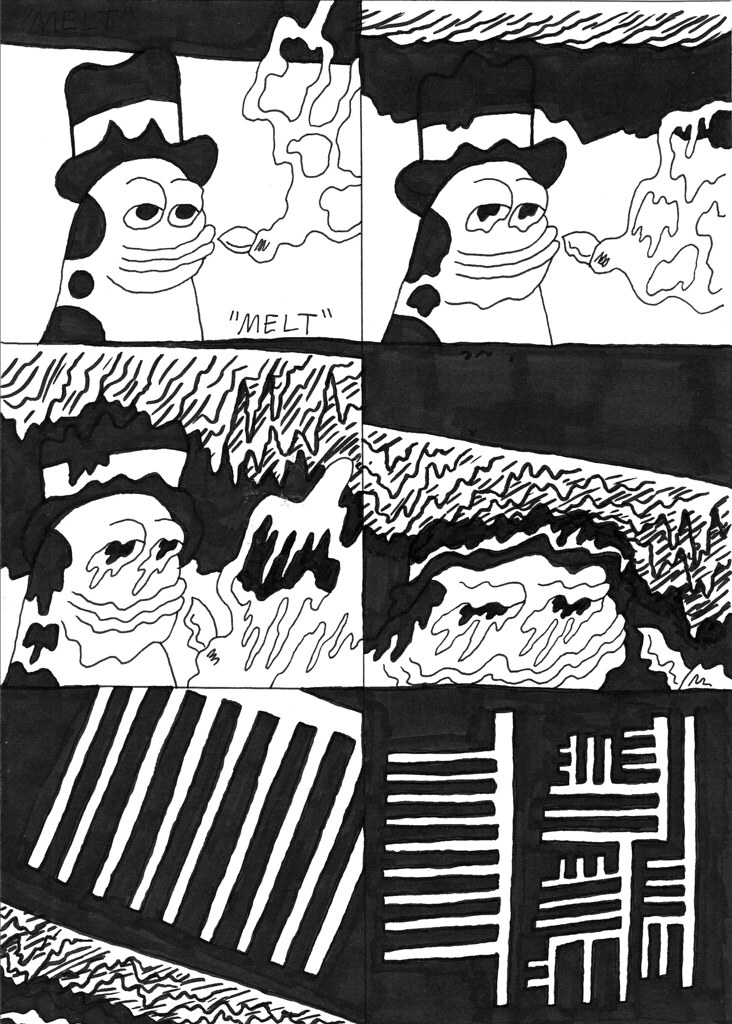
The idea is to do a lot of one to four page comics that depict a single transformation governed by a concise action verb. Here’s an example page, called “Melt”:
I’m doing the comic this way to practice my craft. Every page will be six panels – I’ve already cut the pages and drawn the grid with a pencil. I’m trying to explore transformation and repetition through the medium of cartooning. I’m really excited about this project.
February 3, 2009
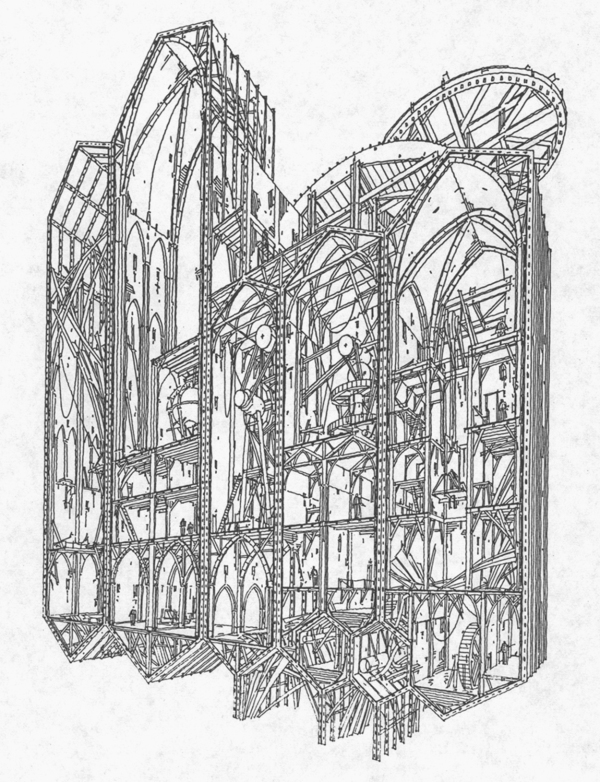
Lebbeus Woods’ Alien III
Lebbeus Woods was hired on as “conceptual architect” for an early, unreleased incarnation of the movie “Alien III”.
The plot sounds like it would’ve been way more interesting:
“The story of the Ward movie was radically different, though it deployed the same basic characters, in that the setting was a religious colony that had escaped the earth and inhabited an abandoned commercial facility deep in space. They had adopted a Medieval way of life, without electricity or modern technology. The Ripley-Alien drama was to be played out inside this crumbling, artificial world.”
via lebbeus woods
January 27, 2009
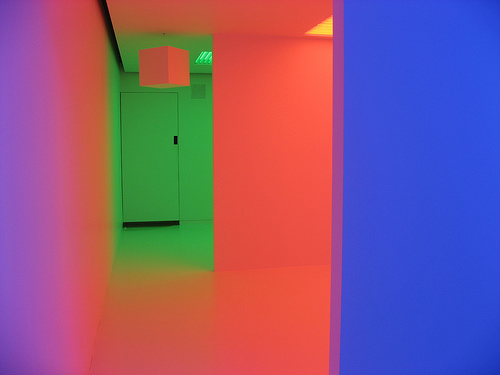
Carlos Cruz-Diez
from twi-ny.com’s flickr
I went to Houston this past weekend and saw the “Color into Light” show at the MFAH. There was some pretty amazing work but the highlight was the installation “Cromosaturacion” (the above image is from a different version in another location). Glade and I at first thought that there was a fog machine in there but no, the light transformed the space so completely that it just seemed like we were walking through a dreamscape. And this was from the mid sixties! Truly a surreal experience.
But beyond that, I recommend the whole show highly. A nice multigenerational, multicultural spectrum of highly aestheticized yet still conceptual work, including some interesting Latin American artists that I had never heard of before, two early 70s Frank Stella paintings, and interactive pieces built in processing/JavaScript/C++. Check it out y’all.
January 20, 2009
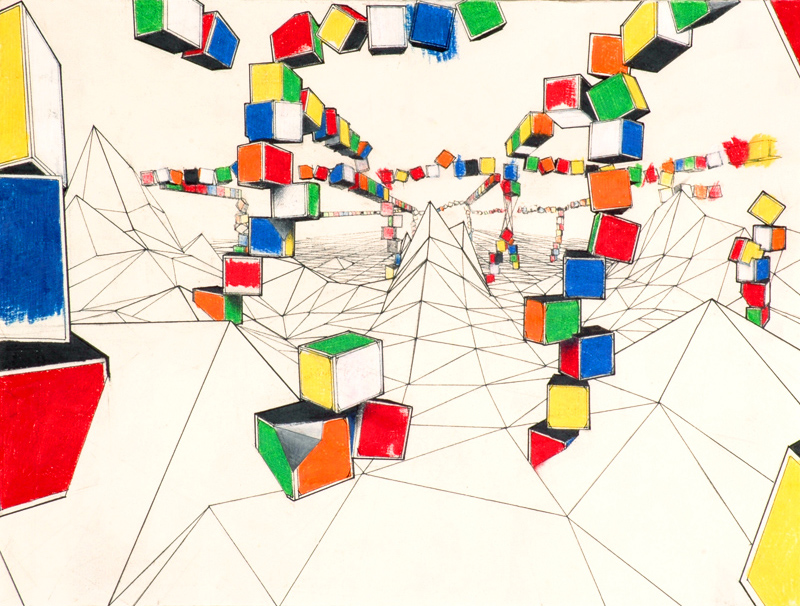
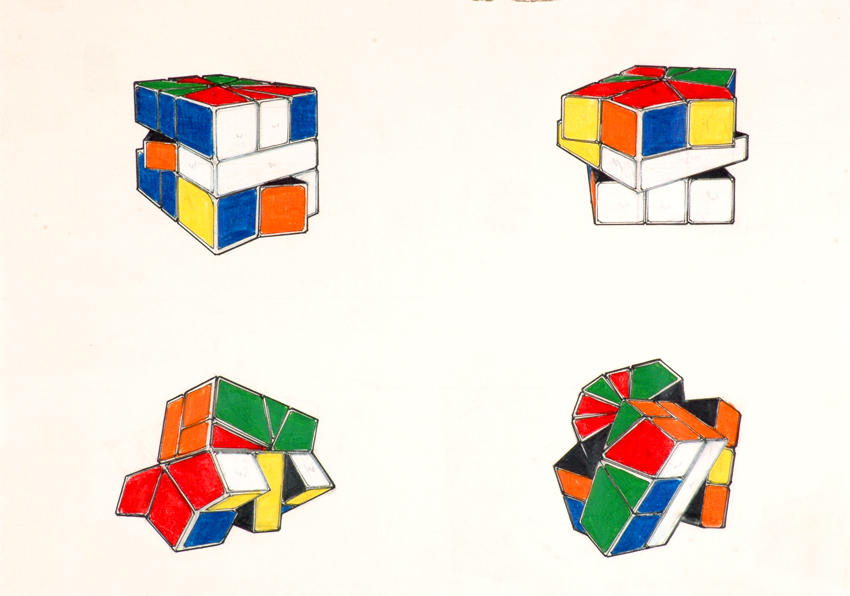
Victor Timofeev
viavictor timofeev
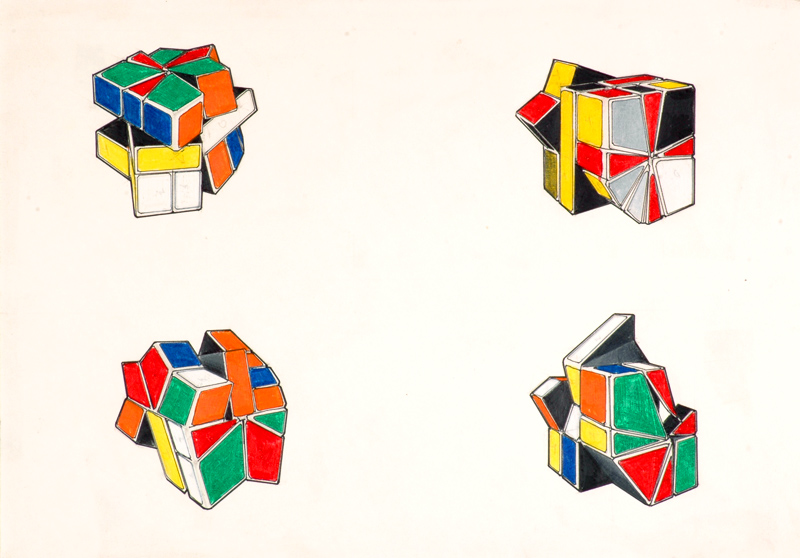
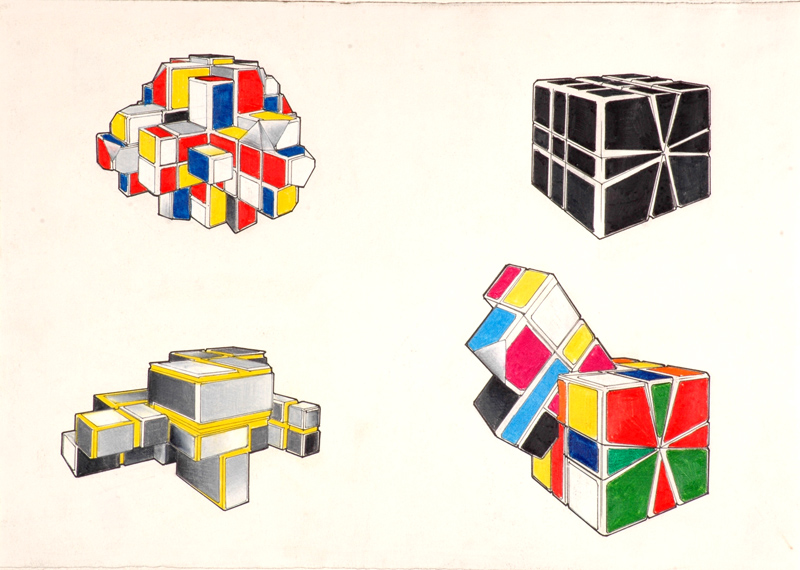
Timofeev’s drawings of fantastic, geometric architectural scenes are amazing. The Rubik’s cube and other, more platonic forms are constantly being transformed, sliced, and placed in strange topologies. Although related to the tradition of abstraction (and pop art, with the Rubik’s), they most strongly recall the drawings of visionary architects. Its interesting to see similar drawings being made without the same intent; namely, to construct something (no matter how improbable that construction may be). These drawings liberate that tradition from ideology so that they can be explored apart from the problematic idea of a utopia. They allow us to enter a world of pure geometric play.
January 18, 2009
Fragment – Hologram Screen
The Hypercastle of the Miizzzard lies deep in the Urscape. It was built in the fold between two ridges of pale orange rock that have pushed through the plains. Here, close to the substrate of reality, the Miizzzard observes the realms of the multiverse and performs his ablutions of the macrocosm.
Through his telescope, he is closely observing the skin of the living multidimensional cosmos. It is pocked and pitted, burned and scared from the violence of its birth. The scorched flesh forms a pattern, a tattoo that is the after-image of its fiery birth. On its other side it is cool, and it casts a three-dimensional shadow onto the walls of its cave.
But the Miizzzard is not interested in shadows. He is closely scanning the skin, looking for infections. On an inverse of the anterior edge of the eleventh-dimensional manifold, he sees a small outcrop of brackish, fuzzy slime that has accumulated enough mass to loom above its crater womb. The Miizzzard blinks and shifts in his seat. From his felt suit coat, he pulls out a worn, turquoise notebook and writes down the eleven coordinate points of the infection from his display.
He gets up and takes the long walk down spiral staircases to the lower floors, working out the stiffness of his joints. The Hypercastle has no foundation, it rests directly on the foamy surface of the Urscape. The Miizzzard is standing in a huge room, his bare feet touching the bedrock of reality. An orb is suspended in the middle of the room, with steps leading up to it and wires stretching away to the darkness of the corners and into the Ursurface. The Miizzzard enters the body cavity within the orb and the door scrapes against the threshold as it closes behind him. Wires painlessly attach themselves into his skin, and suddenly the Miizzzard is no longer himself; he is the living cosmos. He stretches to accustom himself to the new form and cracks open and close in spacetime. Galaxies shatter as he walks across the cave floor, past the fire still burning in the floor form his birth, and to the entrance. There is a silvery, sludgy stream running there, and thin flesh-colored clouds are racing across the sky, but the light is so bright that the Miizzzard-as-the-cosmos must close his eyes as he bends down to the stream to clean himself. The waters are steaming as he washes in a ritual pattern of left then right then left, seventeen times total. He murmurs a prayer that echoes in the quantum flux, and returns to the cave.
In the basement of the Hypercastle, the Miizzzard descends the steps from the orb. He touches his stomach, and begins the long climb to eat his daily meal of bread.
January 16, 2009
The Art World Dream
via Eric Rudd’s website.
I just finished The Art World Dream: Alternative Strategies for Working Artists by Eric Rudd. The idea behind the book is that artists can (and should?) work outside of institutional support to produce great art. You don’t need gallery shows to make major installations, and you don’t need your work to end up in a museum for your work to be preserved for future generations.
And what is the key to freedom? Real estate, and lots of it. The more studio space that you have, he argues, the greater art that you can make (because you have the space to think big). If you own that real estate, you don’t have to worry about gentrification-through-aestheticization raising your rent prices, and you can rent part of it out to fellow artists. A central concept here is that an artist doesn’t really want to be rich – an artist just wants to make enough money to be able to live in some sort of comfort and to keep funding their artwork. Although Rudd mentions the Internet (capital i) several times throughout the book, the one thing he doesn’t mention is perhaps the most important of all – the digital studio is limitless.