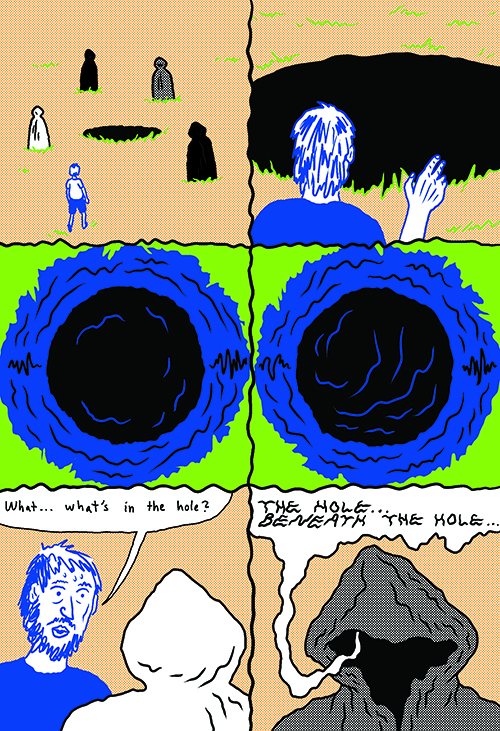
I drew a splash page image for the Sparkplug Books site, check it out:

Sparkplug has Vortex #1-3 in their shop.
I drew a splash page image for the Sparkplug Books site, check it out:
Sparkplug has Vortex #1-3 in their shop.
I’ve added a Vortex #1-4 combo pack to my store. $20 plus shipping for the complete psychedelic adventure: 128 pages of sf madness, melting forms, digital lines, and thick textures. Here are some photos my wife, Glade Hensel, took of the issues:
I sent Vortex #4 to the printer on Wednesday so I’ve put it up for preorder in my store. Here’s a preview:
The preorder price is a dollar off until I get the books in early August. At that point I’ll start shipping out preorders and raise the price to the same as the other issues.
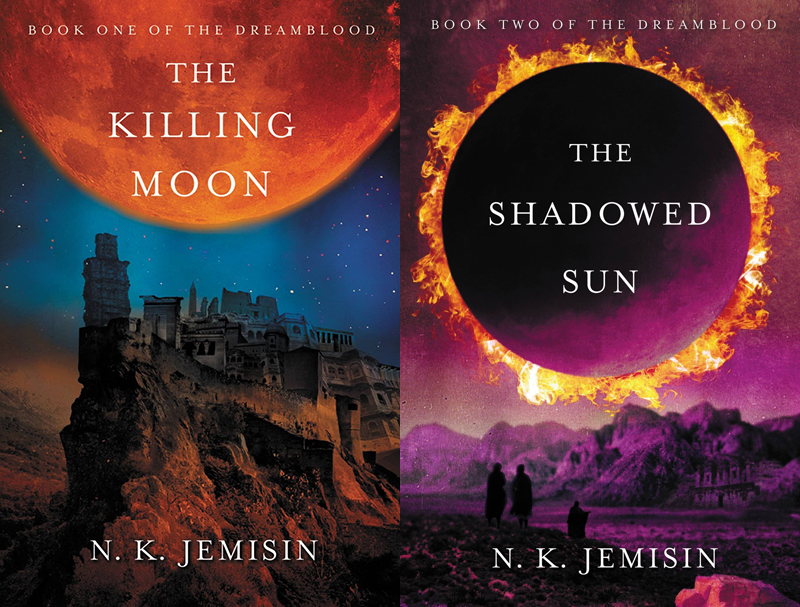
I’ve just finished the Dreamblood duology by NK Jemisin, and I can unequivocally say it’s one of my favorite fantasy series. These books, The Killing Moon and The Shadowed Sun, now sit next to LeGuin’s first three Earthsea books and Hobb’s Farseer series on my mental shelf.
Covers by Marc Yankus.
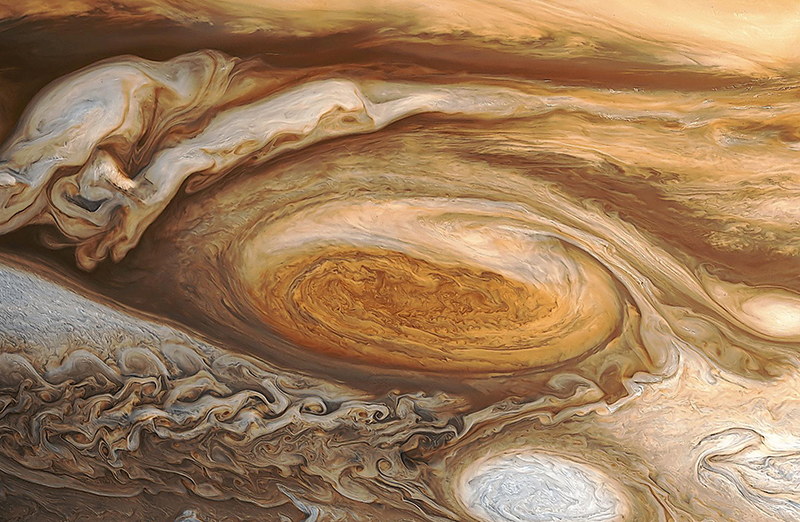
Maybe partially it’s fatigue from overexposing myself to Westeros, but the beautiful writing and novel setting of this duology gave me a serious buzz. Although it’s not explicitly stated in the text of the novel itself, but rather in an interview afterwards, this secondary world fantasy takes place on a moon orbiting a gas giant. The gas giant itself dominates the narrative as the banded Dreaming Moon, which rises and sets over a civilization based on ancient Egypt and its neighbor Nubia.
The Great Red Spot of Jupiter. Photo taken by NASA’s Voyager 1 mission. I’ve always been intrigued by gas giants. It would be amazing to live on a moon orbiting one and see it rise and set.
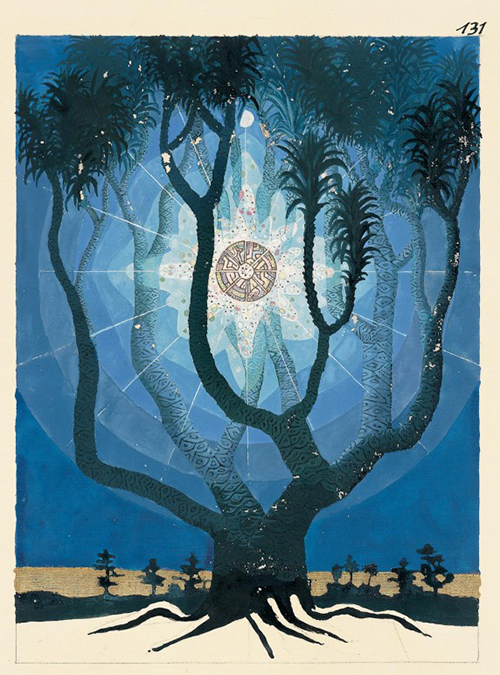
I spent most of my childhood lost in imaginary quasi-medieval settings, so I get their allure, but so many fantasy books seem constrained by these tropes. In the aforementioned interview, Jemisin speaks about the difficulty of making a setting feel real without relying on the familiar tropes of castles and knights, but she succeeds. Jemisin goes even further by throwing out so much of what is recognizably Egyptian – pharoahs and pyramids – instead we get ninja priests and Jungian dream magic. But it’s all grounded by the annual floods of a river enveloped by a vast desert.
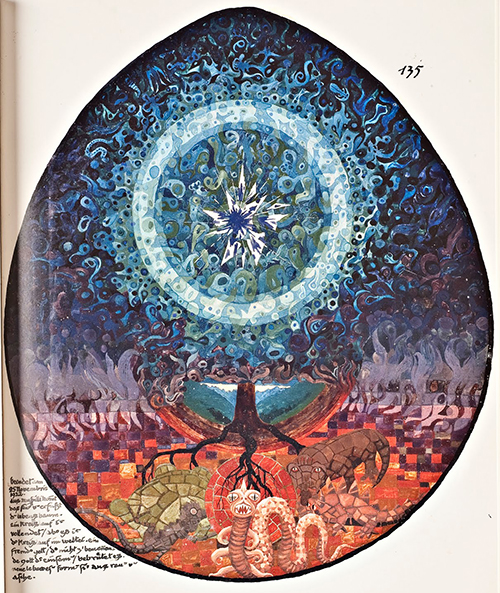
An image from Carl Jung’s Red Book, one of Jemisin’s inspirations.
Another similarity to Earth is that most of the people in this imaginary Egypt, a civilization called Gujaareh, are people of color. Citizens of the Nubian analog, Kisua, use skin color as a sign of social rank – the darker your skin, the more noble your family. There are several characters that an American would identify as white people, but they are secondary characters, Northern barbarians. My mind’s default setting is to imagine that the characters in the novels I’m reading are white unless it’s explicitly stated otherwise. It’s mind expanding to have that assumption, which comes from my privileged position as a white man in America, reversed.
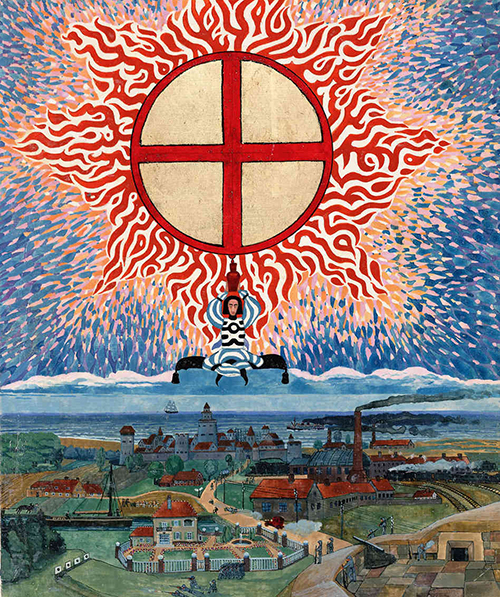
Another image from Carl Jung’s Red Book.
I wish more novelists were brave enough to take what should be the default premise of a fantasy novel – this is a different world and anything goes – as far as Jemisin has in these novels. But enough about what makes The Killing Moon and The Shadowed Sun different. What makes them similar to the best fantasy novels is that they have an exciting plot; an interesting, socially integrated magic system; and deftly done exposition. At its beginning, The Killing Moon is a swirl of unfamiliar terms that are slowly defined through dialog and action rather than chunks of exposition. The plot progresses similarly. There are political schemes behind closed doors but we don’t see the truth until the climax. I enjoyed the emotional journey of the characters in the second book better because we see their relationships develop. In the first book, we’re told about the strong, complex love between a mentor and his apprentice, but their bond was formed before the book begins and it doesn’t waver. Although the plots of the books are linked, they focus on different people and have their own resolutions. At the heart of these novels are troublesome moral questions – Can murder ever be justified? What price should a society pay for peace? Jemisin doesn’t give us any easy answers. She looks at these questions through the eyes of many fully realized characters, both male and female, gay and straight, with diametrically opposed yet reasonable viewpoints.
A third image from Carl Jung’s Red Book.
I highly recommend these novels to anyone looking to explore new territory in their imaginations.
Check out this amazing drawing that Gabriel Corbera made of the Miizzard:
I’m a big fan of Corbera’s comics, especially his Monday Suicide series, an out-there mashup of thick black lines, patterns, monsters, and male pattern baldness.
I’ve dropped copies of Future Shock #4 and Vortex #1-3 off at Farewell Books here in Austin, located in Domy’s old space.
If you’re going to CAKE this weekend in Chicago, Kevin Czap will also have a few copies of the new Future Shock.
I’ve decided to draw the endpapers for this issue. My hand hurts.
I’ve been making good progress on Vortex. I’ve decided that #4 will be the final issue and I’ve pencilled all the way to the end. I’m over halfway done inking it also. My goal is to get the drawing done in June.
I’ve now finished the two five-book cycles that Roger Zelazny set in his Amber cosmos, the Corwin cycle, which I wrote about here, and the Merlin cycle.
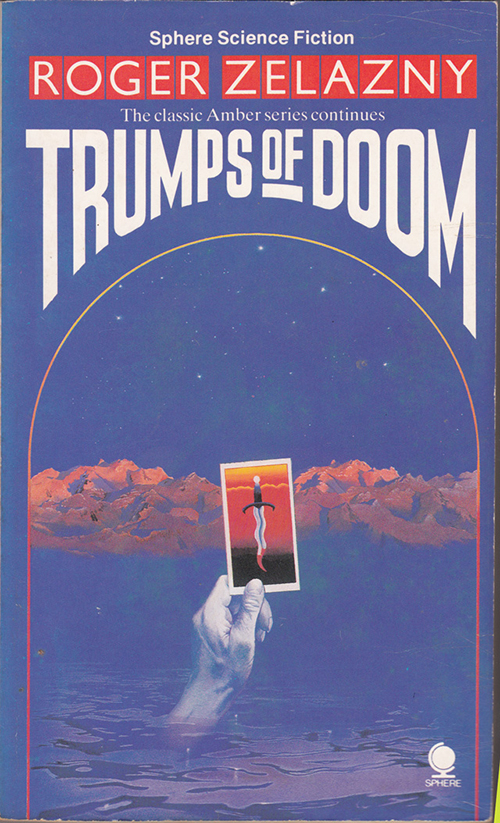
Trumps of Doom is the sixth Amber novel and the first one in the Merlin cycle. Cover by Geoff Taylor.
From reviews I saw on Amazon and Goodreads, I expected to not like the Merlin cycle as much as the Corwin cycle. Maybe it was because of these lowered expectations, but I enjoyed Merlin, maybe more so than Corwin. While Corwin is a charismatic rogue, Merlin is a fair-minded nerd. I wrote about how Corwin ground the first five books with his contemporary sensibility, but now that I’ve read the next five books, I’d amend that – Corwin is modern noir and Merlin is contemporary cyberpunk. As an example, at the beginning of the first book, Trumps of Doom, Merlin has just quit a computer startup in the Bay Area and is going off to check on the artificial intelligence he built in the hinterlands of Shadow.
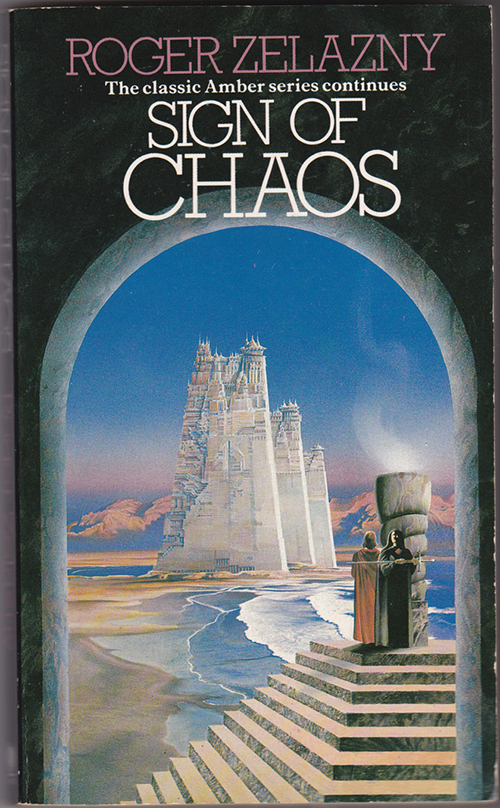
Sign of Chaos is the eighth Amber novel and the third one in the Merlin cycle. Cover also by Geoff Taylor.
In many ways, the Merlin cycle parallels the Corwin cycle structurally. We begin on Earth but are swiftly inducted into Amberite intrigue. We go through several rounds of mysterious betrayals and reversals until the true powers behind events are revealed. The plotting centers on family dynamics and, once again, a missing father. Although Zelazny adds layers of motivations, meanings, and metaphysics to his cosmos, the stakes feel lower this second go round. Both cycles end abruptly, but Prince of Chaos leaves many more threads undone than The Courts of Chaos. I see on Wikipedia that several short stories round out the saga – I’ll track those down.
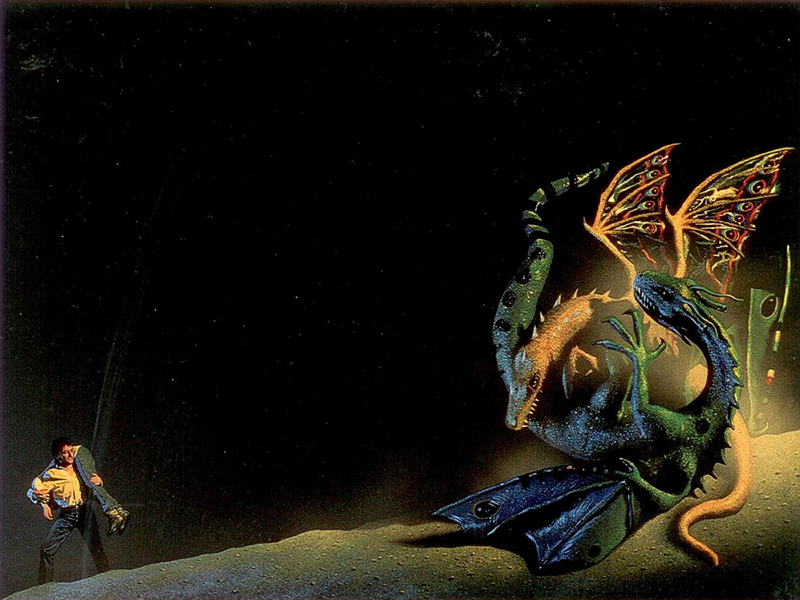
This is the painting that Tim White did for a different cover of Sign of Chaos.
One way in which the Merlin cycle vastly improves on the Corwin cycle is in the portrayal of and roles given to women. The one-dimensional lovers, sisters, and mostly absent mother are replaced with a crowd of vibrant, multi-faceted women. I don’t recall a moment that passes the Bechdel test but Merlin’s complicated (and importantly, changing) relationships with his mother, the mother of his best friend, his ex-girlfriend Julia, and the female demon following him give these novels so much of their depth and drive most of the plot.
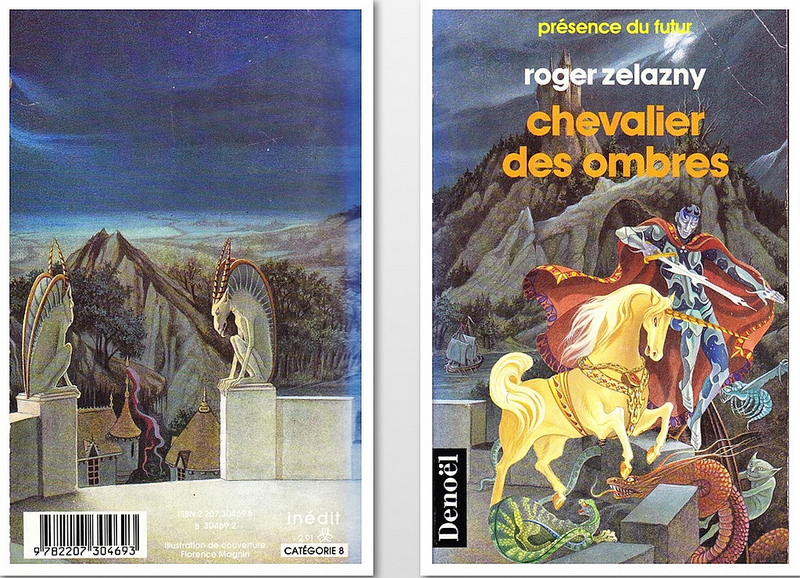
This is the French cover of Knight of Shadows, the ninth Amber novel and the fourth one in the Merlin cycle. Cover by Florence Magnin.
The imagery in the Merlin cycle matches and sometimes exceeds the psychedelia of the Corwin cycle. Not content to simply rehash hellrides through Shadow and the silvery gleam of Tir-na Nog’th, Zelazny shows us the stark stage beneath the puppetry of Shadow and takes us to the pit of Chaos. In between we visit the inhospitable cave where Ghostwheel computes on his otherworldly circuitry and the Mad Hatter’s bar.
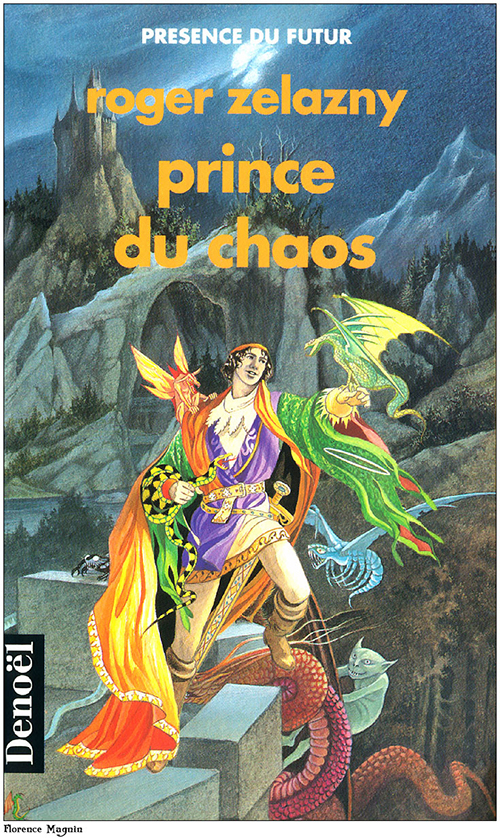
This is the French cover of Prince of Chaos, the tenth Amber novel and the fifth one in the Merlin cycle. Cover also by Florence Magnin.
One of the visual highlights is the beginning of Chapter 7 of the last book, Prince of Chaos, when Merlin walks his step-father’s sculpture garden. It’s a dim room, lit from the ground up, that seems “of different size and contour depending upon where one stood.” The room was “constructed without any plane surfaces.” As you walk through it, the walls become the floor and the sculptures that are on the floor jut out of the walls or depend from the ceiling. I’d love to explore a space like this in a videogame.
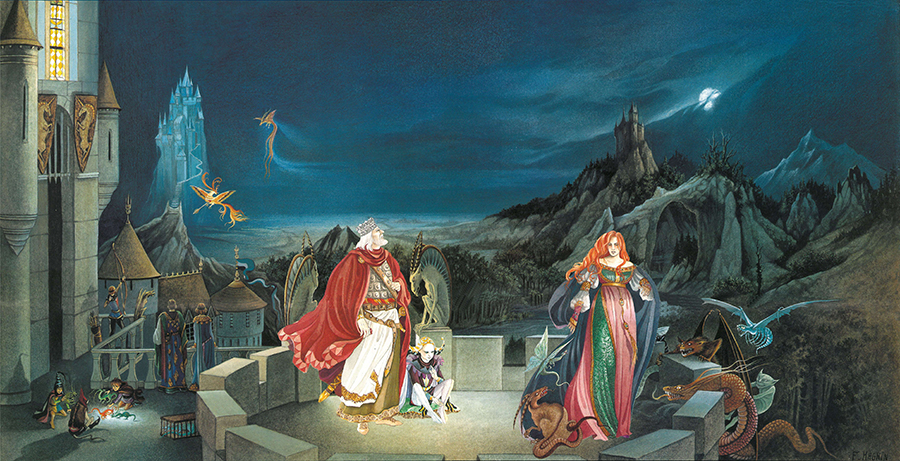
This is an Amber poster by Florence Magnin. It uses elements from her covers. She also did other Amber illustrations. You can see a larger version of this poster here.
In some ways, the strength of an author’s creation can be measured in how reluctant the readers are to leave. I’d like to experience more of Amber and Chaos, although I don’t envy those caught in their power struggles.
I’ve been getting back to work on Vortex #4. I’m finally at the point where finishing the whole story feels like a possibility. I’ve been working on this since the beginning of June in 2011.
Sometimes I use the grid in Manga Studio to sketch out hyperstructures:
Here’s that same page, ready for me to add patterns in Photoshop:
Future Shock #4, edited by Josh Burggraf, is now on sale here through the Birdcage Bottom Books distro.
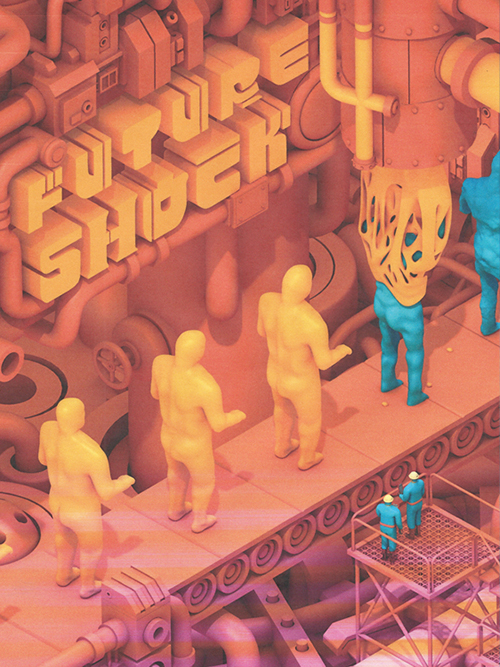
Future Shock #4 cover by Jordan Speer.
Here’s one of the three pages that I did in collaboration with Sean T Collins for this issue:
A page from “The True Black,” written by Sean, drawn by me.
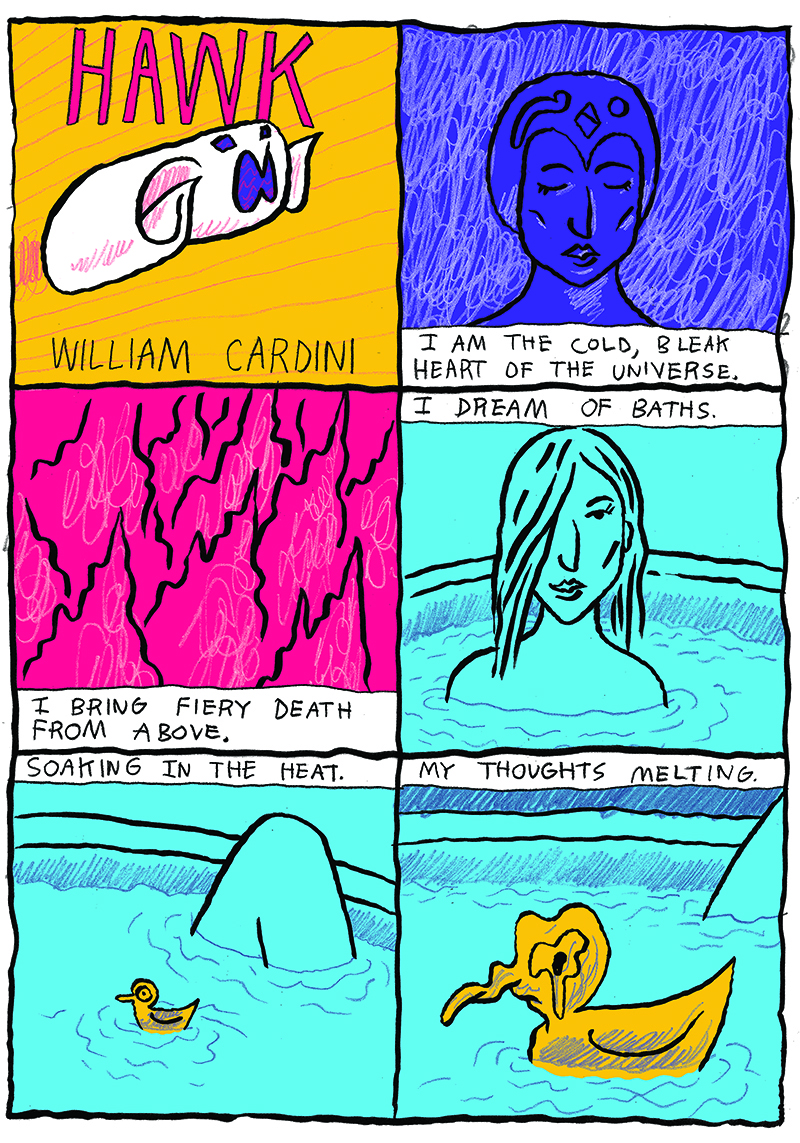
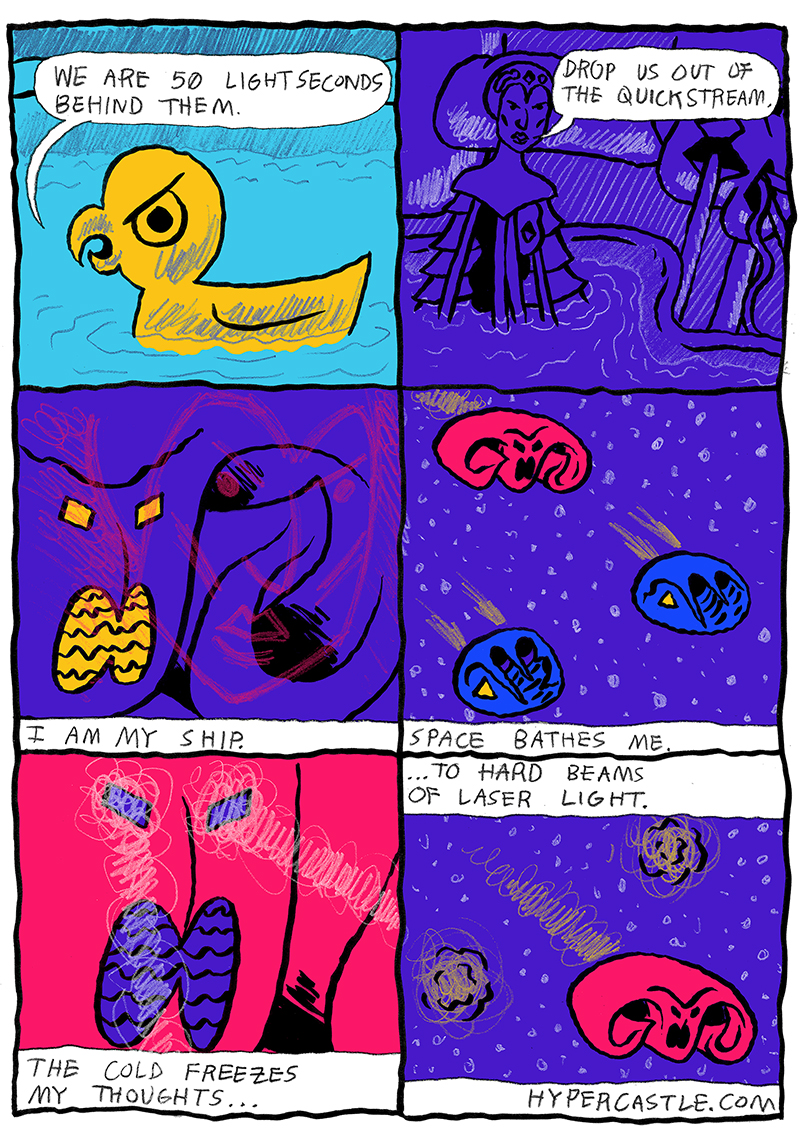
Now that #4 is out and #1 is almost out of print, I thought I’d share my comic “Hawk” that I drew for #1:
For “Hawk” I was experimenting with the pencil-style I used for the comic I drew in Frank Santoro’s correspondence comics course, “Moon Queen.” The story itself was, perhaps too obviously, inspired by M John Harrison’s horrific but beautifully written book Light, which I highly recommend.