Cropped Will Cardini artwork

May 24, 2016

The Futurist Congress of Ari Folman and Robin Wright

Filed under: SF Reviews — Tags: , , — Will Cardini @ 9:15 am

When I first heard that Ari Folman had directed an IRL/animation hybrid adaptation of Stanislaw Lem’s The Futurological Congress that replaces the main role of satirical space explorer Ijon Tichy with the actor Robin Wright and cuts the title to The Congress, I was skeptical but intrigued.

The Futurological Congress by Stanislaw Lem, cover by Stanislaw Fernandes
Cover by Stanislaw Fernandes.

The Futurological Congress is one of my favorite books. It’s Lem out-PKDing Philip K Dick at waking-up-from-a-nightmare-into-another-nightmare psychedelic mind-fucks. Tichy attends the Futurological Congress, which is attacked by terrorists armed with weaponized hallucinogens. Trapped in a trip from which doctors can’t sober him up, they cryogenically freeze Tichy until medical science can find a cure. He wakes up in a future where pharmacologicals are aerosolized and distributed to every citizen to satisfy their every desire. Then it gets weird. What could this plot have to do with the failing acting career of fictionalized Robin Wright?

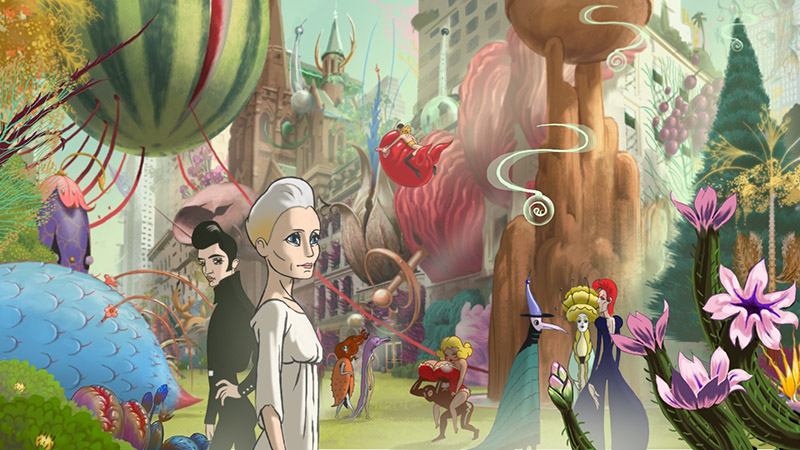
Film still from The Congress
Film still from The Congress.

The movie seems to struggle with reconciling these two threads at well. The animation-less beginning, when Robin Wright is struggling with whether she should let Miramount Studios scan her body so they can use a digital version of her in movies, drags a little. But then we jump forward 20 years to contract renegotiations at the Futurist Congress (an understandable truncation of Lem’s conference title–this would be a better title for the film), which is being held in the animated zone of Abrahama City, and the movies goes all in with zany animation and high SF ideas.

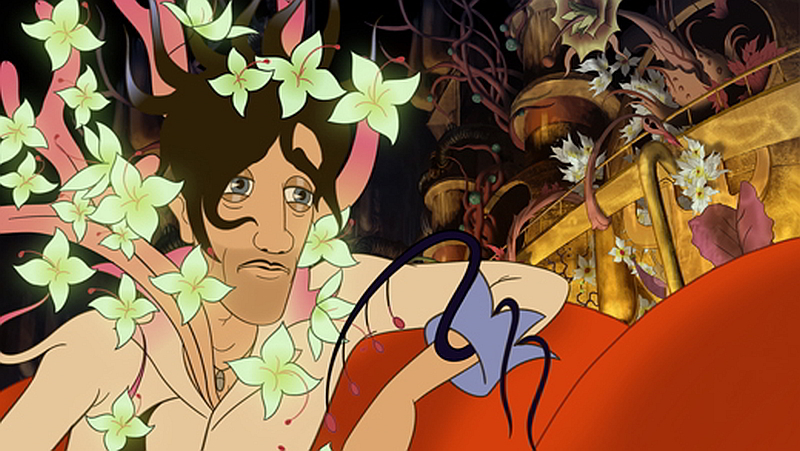
Film still from The Congress
Film still from The Congress.

The writer and director Ari Folman tacks on a story about love and family but otherwise, after Robin Wright attends the Futurist Congress, the plot is surprisingly faithful to Lem’s book, somehow managing to be even more bleak than the very dark and existentially scary book (I’d say more but I don’t want to spoil the finale of either the book or the film, which you should experience for yourself). I really loved the animation and all the sly references to pop culture in the characters and background. The Isreali-based animation studio, Bridgit Folman Films Gang, did a beautiful job. One thing I found interesting in comparing the real-life and cartoon versions of Robin Wright in the same movie is how the exaggerated eyes of cartoon characters work. If they had drawn Wright with eyes in the same proportion as the rest of her, she wouldn’t look as lively. People focus on each other’s eyes so much that it makes sense to enlarge them in a drawing.

Film still from The Congress
Film still from The Congress.

Overall I found The Congress to be a fascinating movie. I’m glad Drafthouse Films picked it up for North American distribution. You should give it a watch (but as always the book is better).

May 17, 2016

Doris Piserchia: Forgotten SF Psychedelia

Filed under: SF Reviews — Tags: , , , , — Will Cardini @ 10:34 pm

Doris Piserchia is an interesting and unfortunately mostly forgotten SF writer. She had 13 books published in the decade from 1973 to 1983, mostly by DAW, two under the pseudonym Curt Selby. Then she quit writing and her books fell out of print.

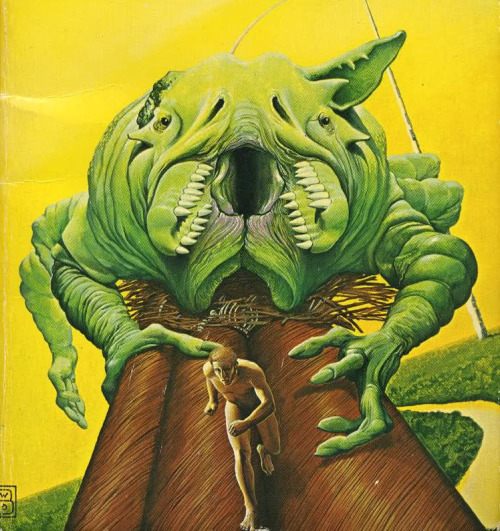
Wayne Barlowe
Wayne Barlowe’s cover painting for Earth in Twilight.

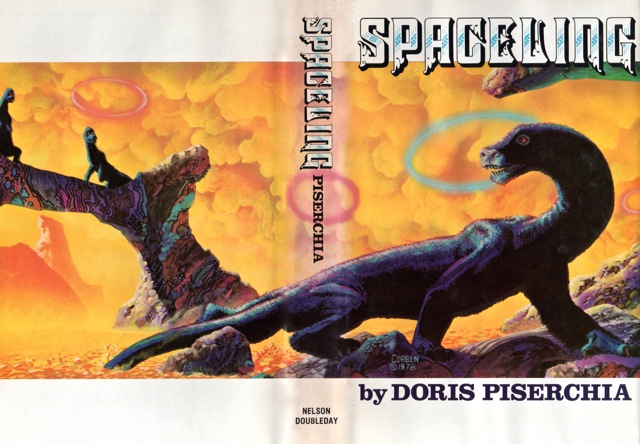
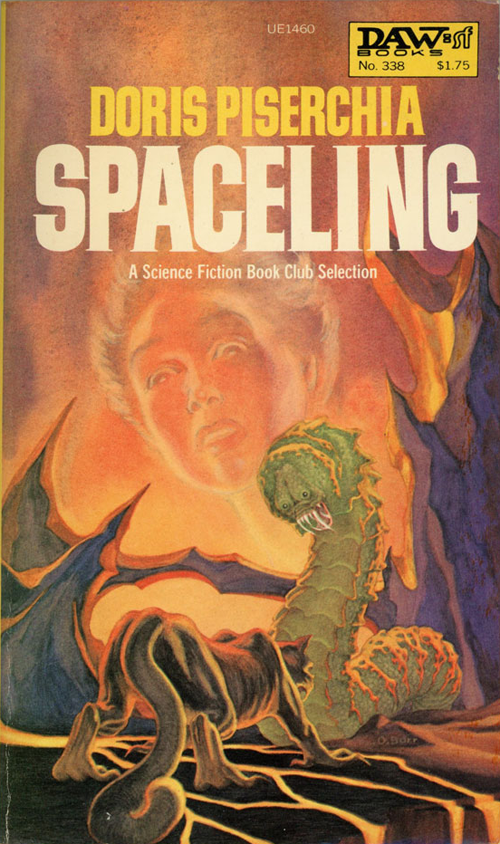
I encountered her work browsing the eye-catching yellow spines of DAW paperbacks at a great used book store here in Kansas City called Prospero’s. The book, Earth in Twilight, had a fantastic monster painting by Wayne Barlowe on the cover. I chose other books that trip but I noted Piserchia’s name for future research. Reviews online and a comparison to Philip K Dick piqued my interest. Then I saw a hardcover of her book Spaceling at a used book store in Lawrence and couldn’t resist the garish Richard Corben cover (Corben is a fantastic cartoonist and fellow Missourian, I get his comics, especially his collaborations with Mignola, regularly).

Spaceling by Doris Piserchia, cover art by Richard Corben
Cover art by Richard Corben.

Spaceling is one of the weirdest books I have ever read. It’s the first-person POV of a teenage girl named Daryl who lives in a post-Peak-Oil, energy-starved Earth where some people can travel to different dimensions via floating rings. These people are called muters because when they travel to another dimension, their body and any items they bring morphs to accommodate their new environment. It’s never quite clear whether these dimensions are other planets in the universe or different universes entirely but it doesn’t really matter. The first two dimensions we encounter are a labyrinthine lava world of vicious monsters called goths, which I found amusing, and a world of endless water and floating mountains. As Piserchia develops the central mystery of her plot, she also ratchets up the psychedelic dimensions by taking us to worlds even further removed from our reality.

Daryl is in many ways a standard SF protagonist, an orphaned amnesiac who gets caught up in events of great import, but the charm of the book is in her meandering, stream-of-conscious narration. It took me a while to get into Piserchia’s prose style, where events are described in a haphazard, piecemeal fashion – some facts are clear at the beginning of a scene but other important details are not mentioned until paragraphs later – but as I relaxed into the story and the setting, I experienced it as a dream, not worrying too much about the underlying logic but just enjoying the journey, and I was happy to discover that the plot resolves satisfactorily.

Spaceling by Doris Piserchia, cover art by George Barr
Cover art by George Barr.

After reading Spaceling, I got Doomtime. It sounded the most interesting to me from reading reviews. Fortunately I didn’t have to hunt it down because Gateway has republished all of her work digitally (and Piserchia is still alive so I feel like my purchase supports her writing).

Doomtime manages to be even stranger (and better) than Spaceling.

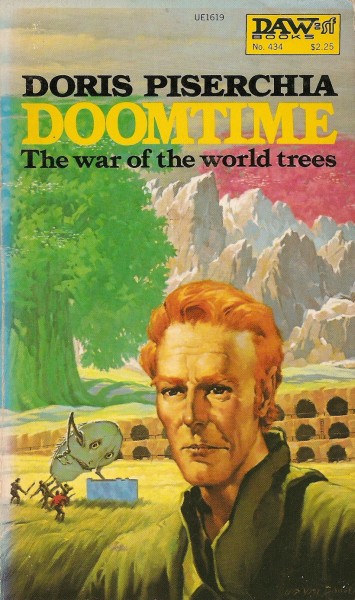
What sets Doomtime apart is the flora and fauna of its setting, which may be an Earth of the far future but could also be another planet entirely. By escaping the somewhat-realistic setting of Spaceling, Piserchia really lets her imagination run wild. Somehow it’s easier for me to suspend any disbelief when the world is totally invented. There are two enormous trees possibly many miles in diameter (the geography of the trees gets difficult to comprehend in the final chapters), a bright green tree named Tendron and a deep vermillion tree named Krake. These trees are sentient, want to conquer the world through their expanding root network, and can communicate with their cloned offspring. People discover they can “dip” in these trees, merging flesh and consciousnesses to experience an addictive bliss. Besides these antagonists, there are the charming Dementia, an enormous land-octopus that stands on three powerful legs and loves destruction; the spiky fungus Morchella, who needs a person to dip so she can communicate between her two brains; and the little six-legged flying twirlies that spin into deadly Looney-Tunes-Tasmanian-Devil-style tornadoes.

Doomtime’s protagonist is a red-haired man named Creed. He travels back and forth across the planet, discovers new societies, and battles the trees. His actions and motivations don’t always make sense but he takes us on a fascinating psychedelic experience.

Doomtime by Doris Piserchia, cover art by H. R. VanDongen
Cover art by H. R. VanDongen.

Color features prominently in Piserchia’s prose. There is the contrast between the green and red of the two warring trees in Doomtime. Daryl’s ability to precisely recall colors in Spaceling is an essential skill in navigating the inter-dimensionsal rings, where a slight difference of hue means a different destination. This focus really appeals to my visual imagination.

Piserchia conjures innovative, otherworldly creatures and environments. She lacks some of the polish of contemporary SF but she also doesn’t follow the same formulas for exposition and plot. I intend to explore her other works and I recommend that you do the same.

October 14, 2015

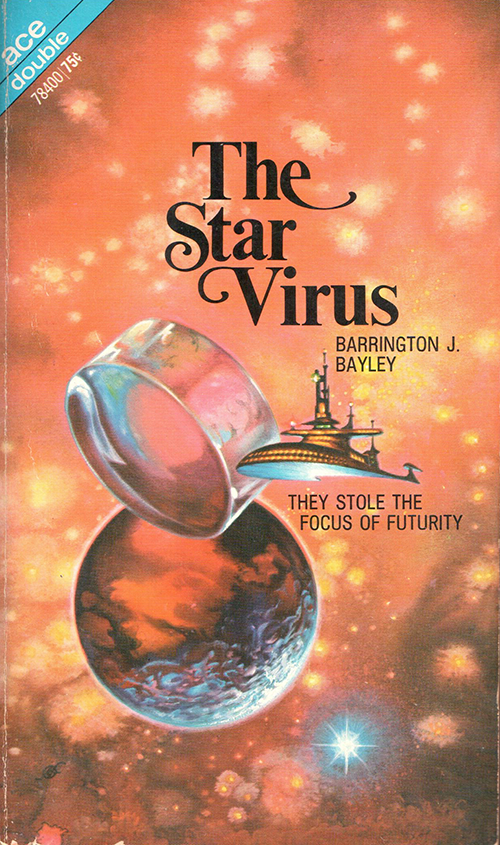
The Star Virus by Barrington J Bayley

Filed under: SF Reviews — Tags: — Will Cardini @ 8:45 pm

I’m ambivalent about The Star Virus and the other two Barrington J Bayley books I’ve read, The Fall of Chronopolis and The Pillars of Eternity. I like how his protagonists are existentialist anti-heroes who get caught up in psychedelic space operas, but I dislike his characters’s nasty misogyny. I have similar reactions to Philip K Dick, but Dick’s psychedelia is so much more spectacular and he makes his protagonists’ troubles with and disdain for women seem so pathetic, so it’s palatable. Bayley is rough edged. His novels are abrasive and bleak but weird and stimulating. He was praised by Michael Moorcock, published short stories in the New Wave magazine New Worlds, and influenced M John Harrison’s space operas The Centauri Device and Light. This influence on one of the greatest contemporary SF authors is especially evident from The Star Virus, Bayley’s first novel.

The Star Virus by Barrington J Bayley cover by Kelly Freas
Cover by Kelly Freas.

The Star Virus opens with the main character, a rogue named Rodrone, admiring the austere, violent landscape of an airless world. I prefer desert landscapes so I instantly grokked that and expected to sympathize with Rodrone but he quickly turns into an asshole, not caring about the loyalty or lives of his crew. In one scene that struck me as particularly hateful, he takes the evil emotional manipulation of a woman who plays a mind-altering musical instrument and extends her behavior to a stereotype of all overweight female musicians, whom he characterizes as craving and jealously hoarding the undeserved attentions of their audience. I can’t help but think that this is based on Bayley’s personal animosity towards someone, because he gives this villainess a normal-sounding name, Ruby, but all the other characters have otherworldly names like Kulthul, Redrace, and Clave Theory.

Mild spoilers and sexual assault trigger warning ahead. (more…)

June 16, 2015

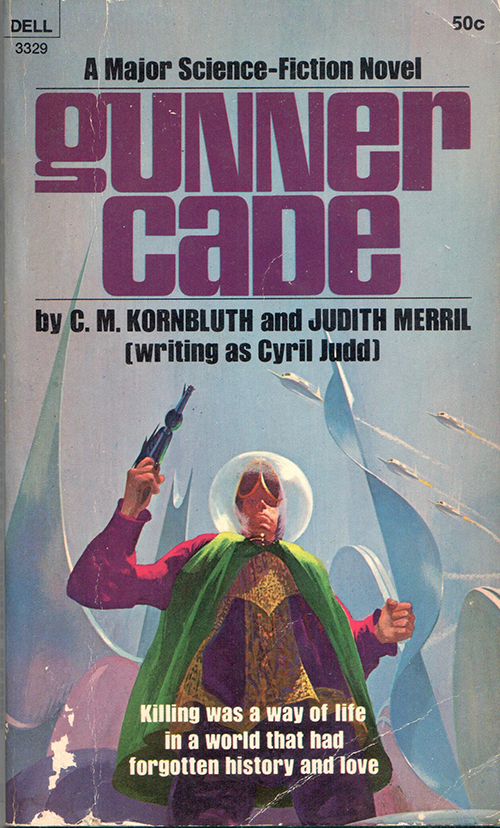
Gunner Cade by Cyril Judd

Filed under: SF Reviews — Tags: , , , — Will Cardini @ 8:23 pm

Gunner Cade, published in 1952, was written by Cyril Judd. The author is not a relative of Donald Judd but is instead a pseudonym for the collaboration of Cyril M Kornbluth and Judith Merril. I haven’t read anything by Merril before but I have read Wolfbane, which Kornbluth wrote with Frederick Pohl and I highly recommend. Merril and Kornbluth both wrote more short stories than novels. Merril was one of the most influential people writing SF in the 50s and later moved to Toronto and was very prominent in the Canadian SF and protest scenes. She founded a SF library collection, an anthology, and most memorably dressed up as a witch to hex the Canadian parliament for allowing U.S. missile tests in Canadian airspace. Kornbluth wrote many collaborative novels but unfortunately died at the peak of his powers in his mid 30’s from a heart attack.

Cover by Paul Lehr
Cover by Paul Lehr.

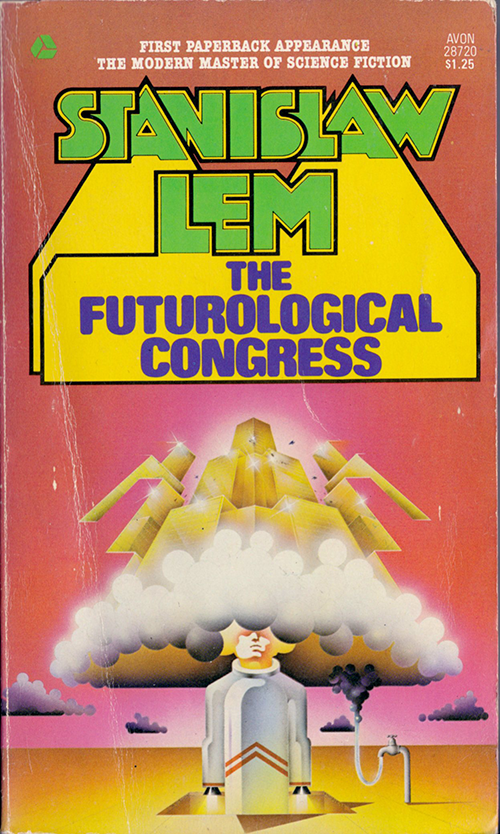
Gunner Cade is a short, swiftly-paced SF novel that includes some incisive social commentary. The titular Cade lives in a far future Earth with an interplanetary society locked in stasis by the interplay between the emperor, nobles who rule different regions such as France and Mars (called Stars), the general (called the Gunner Supreme), and the spymaster (called the Power Master (has CF read this?)). The Gunners are warrior-priests who live an austere, celibate life of ritual centered on their one gun and fatalistic devotion to battle.

Some spoilers and more covers after the cut

February 3, 2015

Who? by Algis Budrys

Filed under: SF Reviews — Tags: — Will Cardini @ 9:18 am

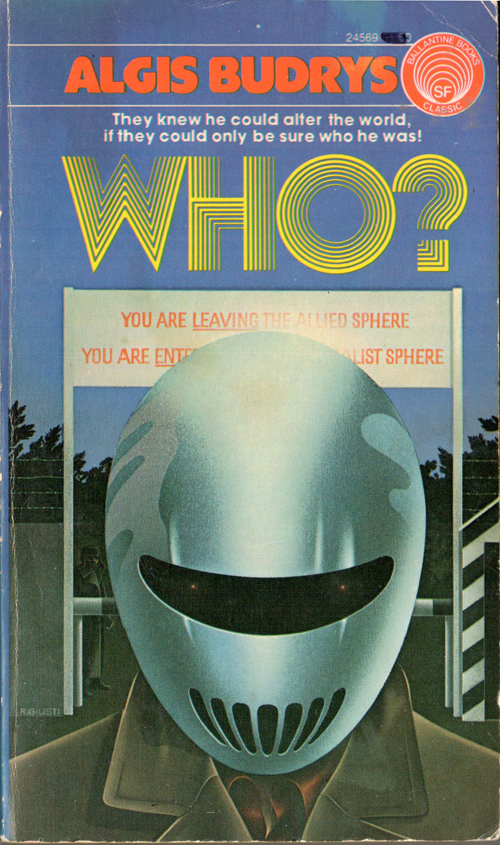
Who? by Algis Budrys is a psychologically tense Cold War SF story, twined around the titular question: who is this faceless cyborg sent back into Western territory by the Soviets – a spy or the brilliant American scientist he claims to be? Lucas Martino is horribly injured in an explosion while he’s working in a top-secret government research project. The Soviets kidnap him from the wreckage for questioning but he can only be saved by an operation that covers his head in an expressionless metal helmet, his eyes glittering lights and his mouth a grill filled with metal blades.

Who by Algis Budrys, cover by Bob Giusti
Cover by Bob Giusti.

The novel alternates between flashbacks of Martino’s life up to the accident and the present-day story of the American spy who watches him to see if he betrays a Soviet allegiance. I was expecting lots of action – the cyborg man has a super strong prosthetic arm and eyes that can see into the infrared – but instead Budrys gives us a character study of a socially awkward scientist who wants to always know exactly how he fits into the universe but is instead cast adrift by both the Soviets who cure him and the Americans whom he hopes will welcome him back. There’s also some body horror as we watch the cyborg adapt to his body – for example, his lips and teeth are gone but his tongue remains, hidden behind metal blades that cut his food up for him.

Some spoilers and themes after the cut

August 21, 2014

Fool’s Assassin Review Followed by an Essay on Gender Fluidity in the Realm of the Elderlings

Filed under: SF Reviews — Tags: , , — Will Cardini @ 10:00 am

I just finished Robin Hobb’s latest book, Fool’s Assassin. I’m going to review it but I’ll warn you when I enter spoiler territory. This book begins a third trilogy starring her beloved duo, Fitz and the Fool. I’ve been a big fan of these two since I first read the Farseer trilogy in the late 90’s. Strangely, however, this will be the first time that I’ll have to wait to read the installments in a Robin Hobb trilogy. I didn’t started any of her previous series until they were complete. It’s going to be a difficult wait. Fortunately Robin Hobb has been steadily finishing about book a year for a couple decades now.

Royal Assassin cover by Michael Whelan
Michael Whelan’s cover for Royal Assassin, the second book starring Fitz.

The pacing of Fool’s Assassin accelerates exponentially. Years pass by at the beginning as we gradually get reintroduced to aging characters and meet new ones. There are a few surprises but 78% percent of the book is slow but powerful emotional arcs. By now, these characters are my old friends, so I enjoyed it immensely. Robin Hobb excels at using first person POV to make her readers deeply invested in the strong feelings of her characters. Incrementally getting to understand the hopes and fears of a middle-aged Fitz and his loved ones makes it all the more excruciating when long-simmering background plots violently flood their lives. The last three chapters of Fool’s Assassin devastated me. While cliffhangers are exciting and send me to forums and on rereads to speculate on what could happen next, they can be cheap thrills. After reading all of Robin Hobb’s published books, I think that endings are one of her weaknesses. The only one that truly satisfied me is the ending to the Tawny Man trilogy.

When I heard that Fool’s Assassin was coming out, I decided to completely read through the interconnected trilogies and quadrilogies of Robin Hobb’s Realm of the Elderlings (RotE) mythos. These series focus on different protagonists and regions on the same fantasy continent, switching between first-person and limited third-person POV. Previously, I had only read the books starring Fitz and the Fool, but at the recommendation of friends, I decided to read the others as well, and I’m glad I did.

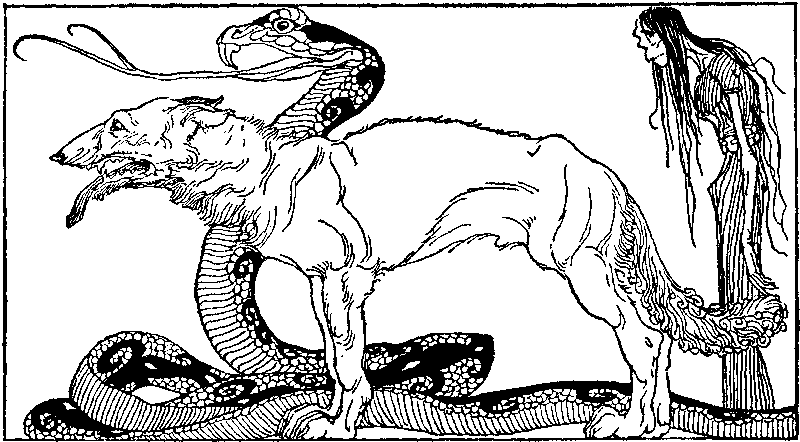
One uncommon aspect of the RotE is that some characters have fluid genders. Fantasy is all-too often a traditional genre that tells repetitive stories in iterative settings. Because the tropes are so well worn and the genre often relies on the authority of kings and other patriarchs, characters that don’t fall into predefined gender roles and threaten that masculine order are often seen as enemies. An example from one of fantasy’s headwaters, myth, is Loki. Loki is the brother of Thor but also shapeshifts into a mare and gives birth to an eight-legged horse. Ze presents as both a man and a woman. Like Loki’s sex, his allegiance to the Aesir is in flux – sometimes ze helps them but sometimes ze thwarts, deceives, and kills them.

Loki's Children by Willy Pogany
Some of Loki’s other children by Willy Pogany. Here’s a family tree for Loki that shows how he switches between mother and father.

I’m going to reveal some spoilers for Robin Hobb and Robert Jordan books from here on out, including Fool’s Assassin in my final paragraph. (more…)

May 15, 2014

Ancillary Justice by Ann Leckie

Filed under: SF Reviews — Tags: — Will Cardini @ 9:55 am

Ancillary Justice is an important sf book. The nominations and awards are justified.

I love how Leckie uses pronouns. The main character, One Esk, is from a human culture, the Radch empire, that doesn’t distinguish between genders, so she refers to everyone with feminine pronouns regardless of how they identify. This is a great effect. It makes me very aware of my internal assumptions. Like most white male Americans, when I imagine a character, I default to white and male unless it’s otherwise specified. But this book doesn’t allow it. In addition to the pronouns, there are a few mentions of skin tone – the majority of the Radch empire are people of color.

Although the pronouns are a world-building detail, One Esk’s genderless perspective never becomes central to the plot. This book handles gender in a radical way but it isn’t about gender like Le Guin’s The Left Hand of Darkness, to which Ancillary Justice has been contrasted. In most other respects, the Radch empire is your typical tyrannical, imperialistic space opera empire. I’m not sure if that’s a missed opportunity, or if it’s more progressive to depict a society without gender as otherwise the same as any other human society.

The other way that Leckie is innovative in her pronoun usage is that, although this book is written from One Esk’s first-person perspective, One Esk is part of a ship hive mind. Her consciousness is distributed among multiple bodies. In the present time of the story, we only see events from the view of one body, but in the alternating flashback chapters, we get sequences where the I telling us the story jumps from location to location. This POV becomes even more complex because One Esk is just one division of a larger ship consciousness, the Justice of Toren. Fortunately, Leckie handles these transitions smoothly. It’s the pleasant buzz of intentional psychedelia, not a confusing mess.

At first I was a bit disappointed with this book. I read Annalee Newitz’s review, where she compares Ancillary Justice to Iain M Banks’s Culture series. I don’t think that Ancillary Justice is quite at that level. For example, both Surface Detail and Ancillary Justice feature embodied ship consciousnesses as major actors. But Banks’s Falling Outside the Normal Moral Constraints feels less human and more alien to me than Leckie’s Justice of Toren One Esk. Maybe that’s part of Leckie’s point.

The motivations of characters are sometimes opaque. There were sections that I had to re-read, not because of the pronouns, but because I wasn’t sure why a character acted in a certain way. There was payoff when I made it to the end but the journey could’ve been smoother. The key is to this novel is to remember that One Esk is an unreliable narrator.

However, this is Leckie’s debut book. I can definitely see the potential for future books to match Banks’s achievement. We know we’re getting more glimpses of this galaxy since this is the first of a loose trilogy.

As far as comparing Ancillary Justice to the entire Wheel of Time series for this year’s Hugo Awards goes, that’s a tough vote for me. My emotional connection to the Wheel of Time is so strong from years of being a fan and anticipating future volumes that I can’t be objective about it. I can’t make up my mind.

October 1, 2013

Barbara Hambly’s The Silent Tower and The Silicon Mage

Filed under: SF Reviews — Tags: — Will Cardini @ 9:04 am

The Silent Tower and The Silicon Mage are the first two books in Barbara Hambly’s portal fantasy series The Windrose Chronicles. For those unfamiliar with the term, a portal fantasy involves travel between two realms: our familiar Earth at some point in history and somewhere else, either Faerie, Heaven, Hell, a dreamscape, or another planet entirely. In this series, the two realms are Los Angeles in the 80s and the Empire of Ferryth on another world. In the first two books, it’s never explicitly stated whether the Empire’s planet is another Earth existing in a parallel dimension or a different planet orbiting a different sun altogether; however, both worlds contain human beings that are sufficiently similar for the same magic spells to work on both. What we are told is that our Earth, the Empire’s planet, and stranger worlds filled with utterly alien beings are all connected by the Void. The Void is only accessible by those with sufficiently advanced technology or magic. Out in the Void, there are drifting centers of power. The distance between a world and a power center determines whether or not magic exists.

So, then, we have the Empire’s planet, at the beginnings of an industrial revolution but still filled with some mages, and our Earth at the 80s, at the beginning of the computer revolution. Although mainframes, Fortran, and floppy disc drives were all in use when Hambly wrote these books, they’re now so outdated that 80s LA just seems like another secondary world, one which I’m more familiar with through old movies and clunky CGI than my own experience. As LP Hartley wrote, “the past is a foreign country.”

It’s interesting to compare the worldbuilding of 80s LA and the Empire of Ferryth. They both feel solid. In this portal fantasy, we’re given a POV from each side and, interestingly, we start in the Empire, with Caris. Although at first it seems that we begin at a generic magic school, where Caris has already graduated as a warrior guard to mages, it becomes clear early on that this world is modeled on a very specific point in history, when factories and programmable looms begin to appear in the cities but the majority of the population are still struggling farmers.

Economics seems like a primary inspiration for Hambly. The most vivid part of Joanna’s Los Angeles experience is her job at a defense contractor, programming missile control systems. Although there are no clouds of coal in her world, there’s the gloomy fog of a potential nuclear armageddon. In the Hambly books that I’ve read, these and Dragonsbane, her protagonists are not the typical fantasy women. They’re average or homely rather than beautiful, middle aged rather than teenagers. Joanna is a blonde, curly haired, shy women who’s more comfortable programming systems at 4am than talking to people, constantly staving off the advances of her seemingly oafish boyfriend Gary. It was very easy for me to identify with her and hope for her to succeed because her job is similar to my day job.

I thoroughly enjoy when Joanna applies her programming expertise to magic, breaking down problems into smaller and smaller, and easier to solve, subroutines. But this isn’t the type of magic that you get in a Brandon Sanderson novel. There’s no unified theory of magic for Joanna to discover, just the Dark Mage to trap and Abominations to destroy. I enjoy the clever construction of Sanderson’s magical systems but sometimes I just want to be awed by mysterious beings who can summon lightning from unknown dimensions.

Caris, who you might at first be fooled into thinking is the hero and love interest, is a young, lithe warrior with a perfectly proportioned face who has trouble thinking for himself and craves the clarity of rules from obvious authority figures. In these first two novels, which form one complete story, Caris is cast adrift with Joanna and the wry, mad mage Antryg Windrose. Antryg is an amazingly crafted character. Throughout The Silent Tower, I was never sure of his intentions, but he charmed me as easily as he charms Caris and Joanna.

The kernel of these novels is the relationship between Joanna and Antryg. When I was in high school I got excited about the romantic relationships in books like the Wheel of Time, where horny teenagers fall for each other at their first meeting because they’re fated to but don’t have the healthiest of relationships. Now that I’m older and married, I prefer Hambly’s depiction of a relationship focused on partnership and mutual respect on top of attraction. Joanna and Antryg do have to work out their trust and communication issues, but what relationship is ideal?

There’s one unfortunate aspect of these books that prevents me from whole-heartedly recommending them. There’s one gay character who falls into the trope of decadent, depraved homosexual. Although Joanna sees his good qualities, she still refers to him as a “pervert.” This isn’t central to the book but I can’t blame anyone for finding this an insurmountable obstacle.

I’m going to leave y’all with one of my favorite moments. It’s a great example of Hambly’s all-too-realistic focus on economics but is a bit spoilery. In The Silicon Mage, Antryg and Joanna encounter a much hyped-up evil, an intelligent Abomination from another dimension. When they encounter the demon in its gorey lair, they discover that it’s not some fearsome hellspawn intent on devouring souls, but a low-level office worker who’s trapped in a world he doesn’t understand, trying to communicate the only way he can: through a body composed of human corpses. Even more humorously, he’s an technician like Joanna; only instead of computer systems, he works with xchi particles.

July 9, 2013

The Dreamblood Duology by NK Jemisin

Filed under: SF Reviews — Tags: — Will Cardini @ 11:20 am

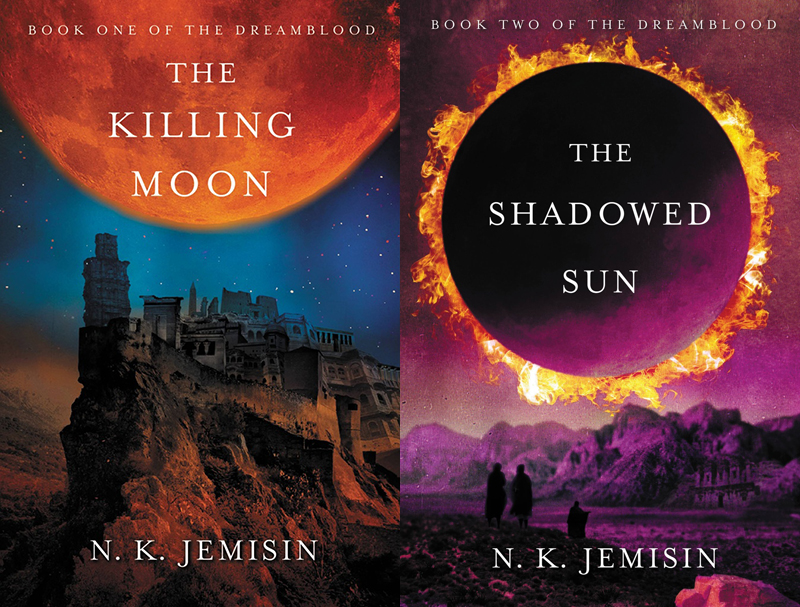
I’ve just finished the Dreamblood duology by NK Jemisin, and I can unequivocally say it’s one of my favorite fantasy series. These books, The Killing Moon and The Shadowed Sun, now sit next to LeGuin’s first three Earthsea books and Hobb’s Farseer series on my mental shelf.

Jemisin's Dreamblood duology, covers by Marc Yankus
Covers by Marc Yankus.

Maybe partially it’s fatigue from overexposing myself to Westeros, but the beautiful writing and novel setting of this duology gave me a serious buzz. Although it’s not explicitly stated in the text of the novel itself, but rather in an interview afterwards, this secondary world fantasy takes place on a moon orbiting a gas giant. The gas giant itself dominates the narrative as the banded Dreaming Moon, which rises and sets over a civilization based on ancient Egypt and its neighbor Nubia.

The Great Red Spot of Jupiter
The Great Red Spot of Jupiter. Photo taken by NASA’s Voyager 1 mission. I’ve always been intrigued by gas giants. It would be amazing to live on a moon orbiting one and see it rise and set.

I spent most of my childhood lost in imaginary quasi-medieval settings, so I get their allure, but so many fantasy books seem constrained by these tropes. In the aforementioned interview, Jemisin speaks about the difficulty of making a setting feel real without relying on the familiar tropes of castles and knights, but she succeeds. Jemisin goes even further by throwing out so much of what is recognizably Egyptian – pharoahs and pyramids – instead we get ninja priests and Jungian dream magic. But it’s all grounded by the annual floods of a river enveloped by a vast desert.

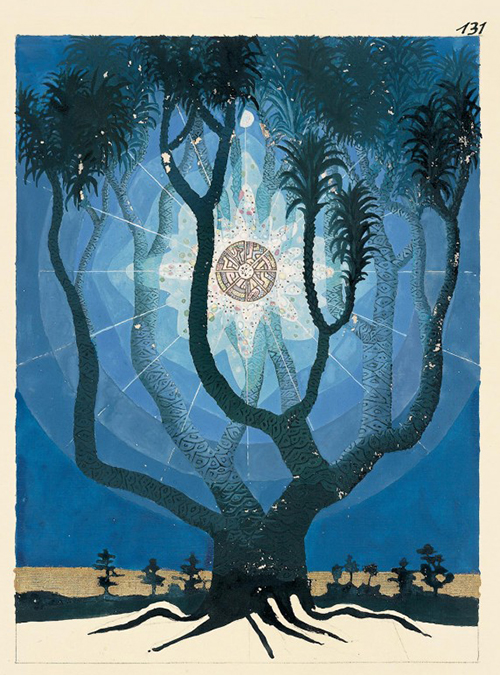
The Red Book by Jung
An image from Carl Jung’s Red Book, one of Jemisin’s inspirations.

Another similarity to Earth is that most of the people in this imaginary Egypt, a civilization called Gujaareh, are people of color. Citizens of the Nubian analog, Kisua, use skin color as a sign of social rank – the darker your skin, the more noble your family. There are several characters that an American would identify as white people, but they are secondary characters, Northern barbarians. My mind’s default setting is to imagine that the characters in the novels I’m reading are white unless it’s explicitly stated otherwise. It’s mind expanding to have that assumption, which comes from my privileged position as a white man in America, reversed.

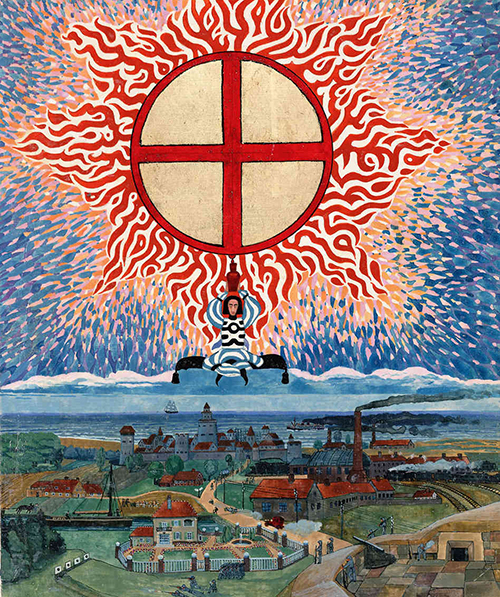
The Red Book by Jung
Another image from Carl Jung’s Red Book.

I wish more novelists were brave enough to take what should be the default premise of a fantasy novel – this is a different world and anything goes – as far as Jemisin has in these novels. But enough about what makes The Killing Moon and The Shadowed Sun different. What makes them similar to the best fantasy novels is that they have an exciting plot; an interesting, socially integrated magic system; and deftly done exposition. At its beginning, The Killing Moon is a swirl of unfamiliar terms that are slowly defined through dialog and action rather than chunks of exposition. The plot progresses similarly. There are political schemes behind closed doors but we don’t see the truth until the climax. I enjoyed the emotional journey of the characters in the second book better because we see their relationships develop. In the first book, we’re told about the strong, complex love between a mentor and his apprentice, but their bond was formed before the book begins and it doesn’t waver. Although the plots of the books are linked, they focus on different people and have their own resolutions. At the heart of these novels are troublesome moral questions – Can murder ever be justified? What price should a society pay for peace? Jemisin doesn’t give us any easy answers. She looks at these questions through the eyes of many fully realized characters, both male and female, gay and straight, with diametrically opposed yet reasonable viewpoints.

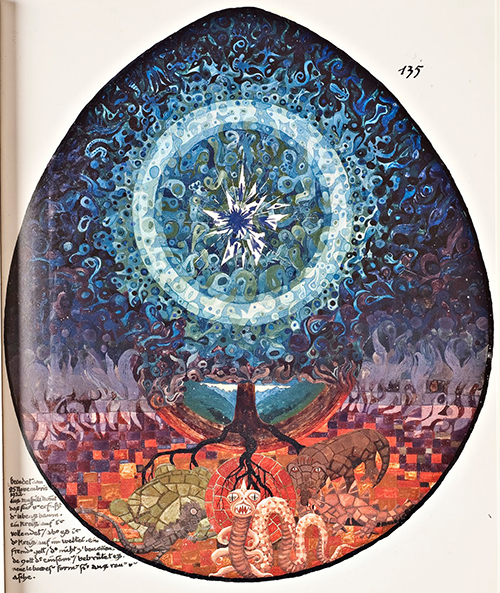
The Red Book by Jung
A third image from Carl Jung’s Red Book.

I highly recommend these novels to anyone looking to explore new territory in their imaginations.

June 4, 2013

Roger Zelazny’s Chronicles of Amber – the Merlin Cycle

Filed under: SF Reviews — Tags: , — Will Cardini @ 11:00 am

I’ve now finished the two five-book cycles that Roger Zelazny set in his Amber cosmos, the Corwin cycle, which I wrote about here, and the Merlin cycle.

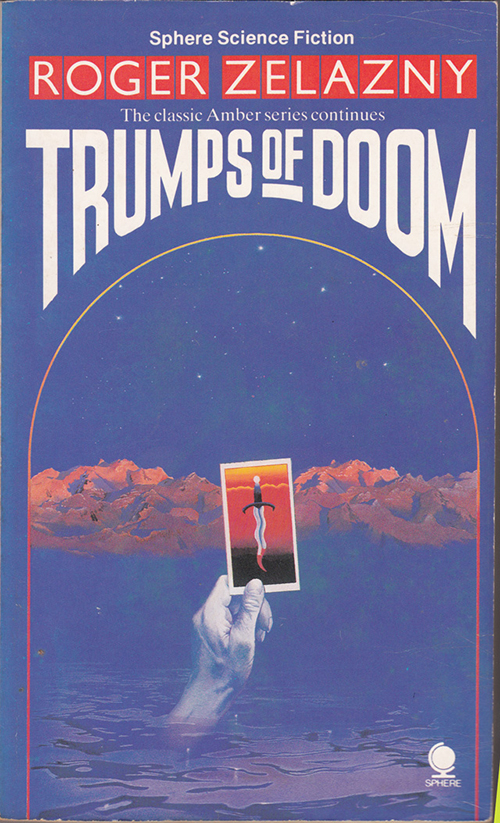
Trumps of Doom by Zelazny, cover by Geoff Taylor
Trumps of Doom is the sixth Amber novel and the first one in the Merlin cycle. Cover by Geoff Taylor.

From reviews I saw on Amazon and Goodreads, I expected to not like the Merlin cycle as much as the Corwin cycle. Maybe it was because of these lowered expectations, but I enjoyed Merlin, maybe more so than Corwin. While Corwin is a charismatic rogue, Merlin is a fair-minded nerd. I wrote about how Corwin ground the first five books with his contemporary sensibility, but now that I’ve read the next five books, I’d amend that – Corwin is modern noir and Merlin is contemporary cyberpunk. As an example, at the beginning of the first book, Trumps of Doom, Merlin has just quit a computer startup in the Bay Area and is going off to check on the artificial intelligence he built in the hinterlands of Shadow.

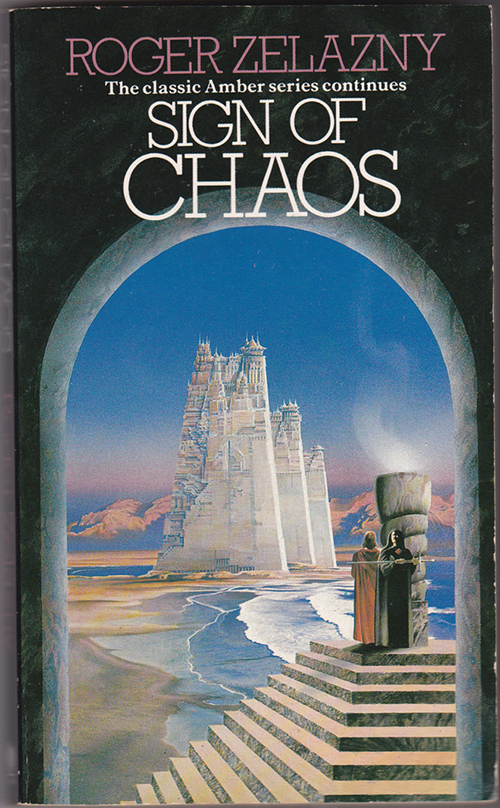
Sign of Chaos by Zelazny, cover by Geoff Taylor
Sign of Chaos is the eighth Amber novel and the third one in the Merlin cycle. Cover also by Geoff Taylor.

In many ways, the Merlin cycle parallels the Corwin cycle structurally. We begin on Earth but are swiftly inducted into Amberite intrigue. We go through several rounds of mysterious betrayals and reversals until the true powers behind events are revealed. The plotting centers on family dynamics and, once again, a missing father. Although Zelazny adds layers of motivations, meanings, and metaphysics to his cosmos, the stakes feel lower this second go round. Both cycles end abruptly, but Prince of Chaos leaves many more threads undone than The Courts of Chaos. I see on Wikipedia that several short stories round out the saga – I’ll track those down.

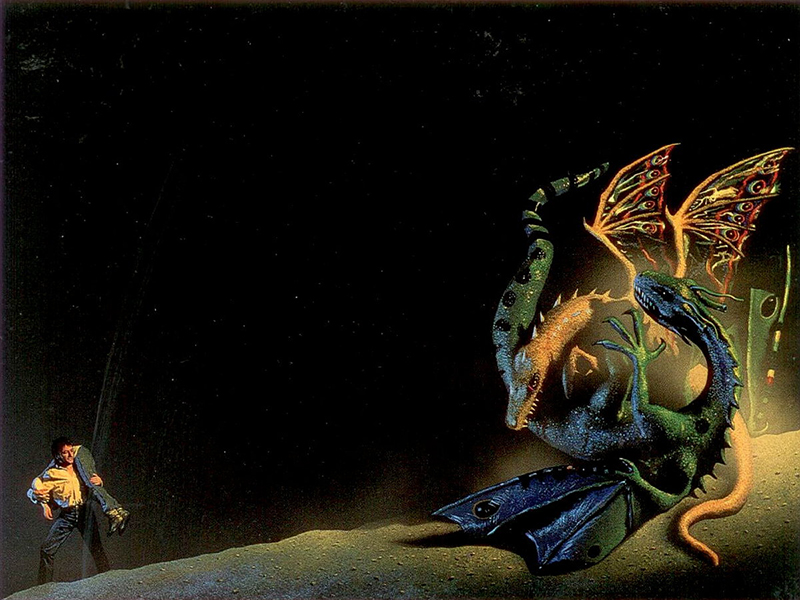
Tim White cover painting for Sign of Chaos by Zelazny
This is the painting that Tim White did for a different cover of Sign of Chaos.

One way in which the Merlin cycle vastly improves on the Corwin cycle is in the portrayal of and roles given to women. The one-dimensional lovers, sisters, and mostly absent mother are replaced with a crowd of vibrant, multi-faceted women. I don’t recall a moment that passes the Bechdel test but Merlin’s complicated (and importantly, changing) relationships with his mother, the mother of his best friend, his ex-girlfriend Julia, and the female demon following him give these novels so much of their depth and drive most of the plot.

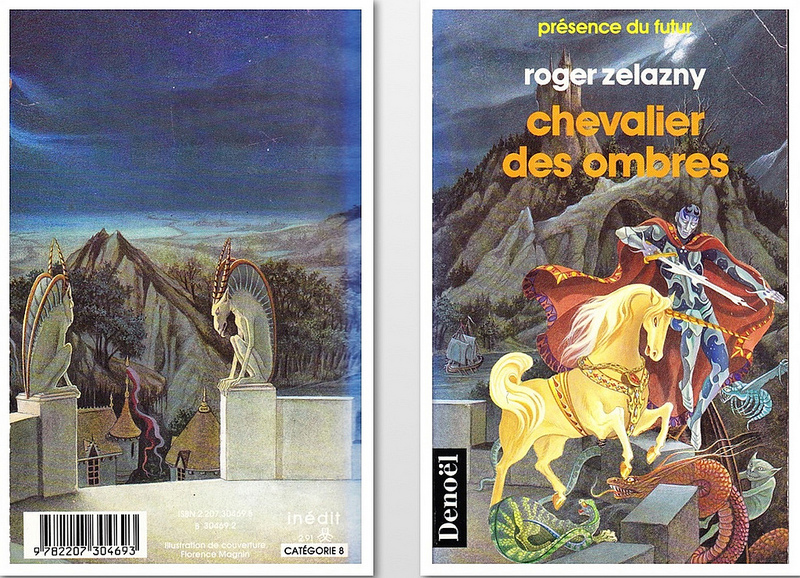
French cover of Knight of Shadows by Zelazny, cover by Florence Magnin
This is the French cover of Knight of Shadows, the ninth Amber novel and the fourth one in the Merlin cycle. Cover by Florence Magnin.

The imagery in the Merlin cycle matches and sometimes exceeds the psychedelia of the Corwin cycle. Not content to simply rehash hellrides through Shadow and the silvery gleam of Tir-na Nog’th, Zelazny shows us the stark stage beneath the puppetry of Shadow and takes us to the pit of Chaos. In between we visit the inhospitable cave where Ghostwheel computes on his otherworldly circuitry and the Mad Hatter’s bar.

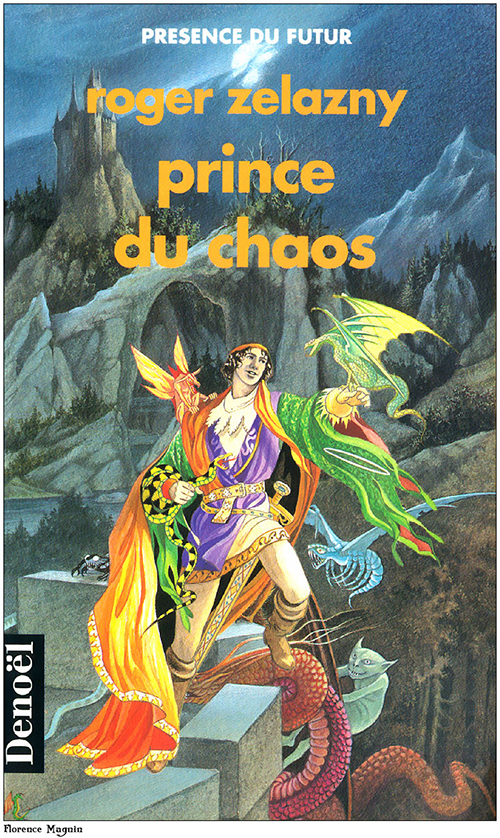
French cover of Prince of Chaos by Zelazny, cover by Florence Magnin
This is the French cover of Prince of Chaos, the tenth Amber novel and the fifth one in the Merlin cycle. Cover also by Florence Magnin.

One of the visual highlights is the beginning of Chapter 7 of the last book, Prince of Chaos, when Merlin walks his step-father’s sculpture garden. It’s a dim room, lit from the ground up, that seems “of different size and contour depending upon where one stood.” The room was “constructed without any plane surfaces.” As you walk through it, the walls become the floor and the sculptures that are on the floor jut out of the walls or depend from the ceiling. I’d love to explore a space like this in a videogame.

Amber poster by Florence Magnin
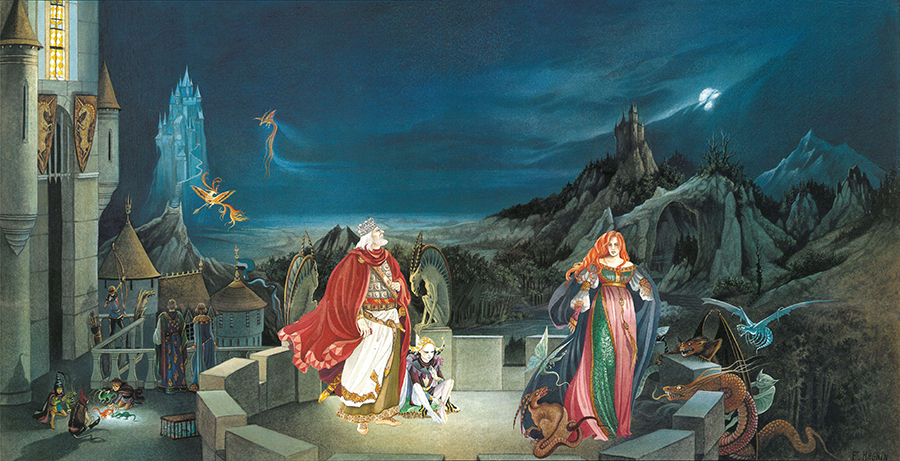
This is an Amber poster by Florence Magnin. It uses elements from her covers. She also did other Amber illustrations. You can see a larger version of this poster here.

In some ways, the strength of an author’s creation can be measured in how reluctant the readers are to leave. I’d like to experience more of Amber and Chaos, although I don’t envy those caught in their power struggles.