Cropped Will Cardini artwork

August 4, 2022

Post-Human Scams and Spies

Filed under: SF Reviews — Tags: , — Will Cardini @ 11:08 am

I’ve recently finished Charles Stross’ Freyaverse series: the novel Saturn’s Children (2008), the short story Bit Rot (2010), and the novel Neptune’s Brood (2013). The books had been on my to-read pile for a while because I’ve enjoyed his other space operas, especially Glasshouse.

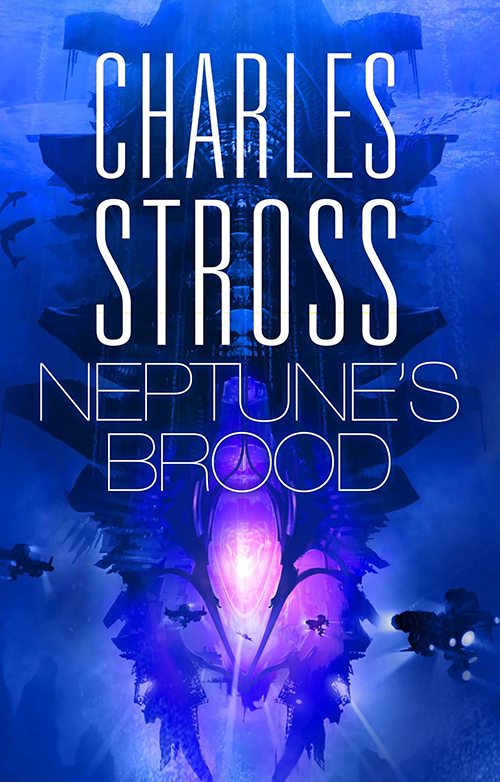
Cover of Neptunes Brood by Charles Stross, cover art by Fred Gambino
This cover for the UK edition was painted by Fred Gambino.

The premise of Saturn’s Children is fantastic. It’s set in a future where humanity has created colonies across the solar system, but has since died out, leaving our artificially intelligent robotic creations to carry on a post-human civilization without us. One important conceptual detail is that even though these are manufactured beings, their brains are basically the same as ours: human engineers couldn’t figure out how to create general artificial intelligence from scratch, so they built artificial emulations of human brains.

One could imagine a sort of Bechdel Test for SF books about robots: do two artificial intelligences talk to each other about something other than humans? These books would easily pass, although they’re still ultimately about humans: our foibles and narcissisms are on center stage.

Click here to read spoilery details

July 31, 2018

An Ingenious, Anti-Capitalist Alien Invasion Story

Filed under: SF Reviews — Tags: , — Will Cardini @ 8:01 am

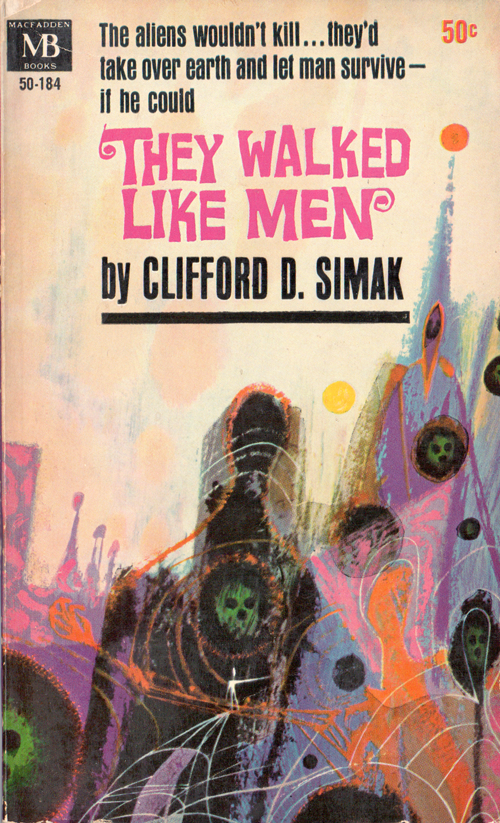
They Walked Like Men by Clifford D Simak is one of the most clever alien invasion stories I have ever read. It’s also an exploration of the downsides of private property and capitalism which surprised me from Simak, who doesn’t usually talk about economics in his novels.

They Walked Like Men by Clifford D Simak back cover
Cover artist unknown, MacFadden Books 1963.

This book is written in the first-person POV of Patrick Graves, a science journalist for a city newspaper. The book doesn’t say what year it is but it was published in 1962 and doesn’t have any SF elements other than the aliens. Simak was a journalist so I would guess that he was heavily mining from his experience for the milieu. It makes it more real and offers us a glimpse into a job that doesn’t exist in the same form anymore.

One curious aspect to the setting is that Simak never specifies the name of city in which this story is set. It feels like a mid-sized midwestern city. From his other novels I know that’s where he usually sets his stories because that’s where he lived but it does make some of the phrasing awkward when Simak is trying to dance around naming the city outright. A novelist should pick a place to tell their story and tells us where that place is.

Graves is a bit of a drunk and a misogynist. In many ways Graves exemplifies stereotypes I have about how a typical man in the 1950’s to early 60’s would think about things like drinking and women.

Simak does a terrific job conveying the dread that Graves feel as the alien invasion upends his sense of comfort and normalcy. Here’s a choice quote from page 87 of the 1963 MacFadden Books edition:

Now I saw the great black of the night outside and could sense the coldness and the arrogance that held the world entrapped. The room contracted to a cold place of gleaming light shattering on the shine of the laboratory bench and the sink and glassware, and I was a feebleness that stood there…

As someone who suffers from anxiety and panic attacks, I can testify that this is an accurate description of what it feels like when panic begins.

I won’t spoil the ending but I am going to describe the clever premise. I went into it with no prior knowledge of the plot (I didn’t even read the back cover copy) just a strong appreciation for Simak’s writing and themes (I’ve also reviewed his book The Werewolf Principle) so be forewarned that I’m going into detail about things the book slowly reveals in the following paragraphs.

Click here to read spoilery details

July 25, 2017

The Ends of the World by Peter Brannen

Filed under: SF Reviews — Tags: , , — Will Cardini @ 8:36 am

Isn’t it strange that you could travel back in time to a point in the Earth’s history when the very atmosphere could poison you?

Of course there are the long years before life on Earth had evolved and there was no oxygen at all. But there have also been at least one period of high oxygen levels when insects could grow to gargantuan size and several periods of extremely high carbon dioxide levels.

In a post on The Atlantic site by science writer Peter Brannen called “Burning Fossil Fuels Almost Ended All Life on Earth,” Brannen vividly details what it would be like to visit one such era, the Permian-Triassic boundary around 250 million years ago:

You walk down to the shoreline and take a few steps into the lapping waters, drawn toward the enveloping gloom. The seawater is almost painfully hot. There’s nothing alive under the waves. There doesn’t seem to be anything alive anywhere really. You squint and marvel at the growing terror on the horizon. You’ve seen billowing thunderclouds before, but this panoramic tempest seems to tower into eternity. Wild hot winds begin to whip in all directions. You find it difficult to breathe. Slowly baking, you know should head back to the temporary safety of the ship, but you linger here all alone on the dimming coast, transfixed by the blossoming apocalypse just over the Earth’s curve. A putrid odor begins to ride in on the swirling winds and, as you finally turn back in a panic, you pass out. Before long, this doomsday storm makes landfall, and what meager life clings to this country is stamped out for millions of years.

Because of this great writing, I bought Brannen’s debut book, The Ends of the World, which came out this past June. It’s a clever, often times beautifully written account of the past five mass extinctions in the deep past of the Earth, when almost all complex species were destroyed by overwhelming geological and astronomical forces. Like the best science writing (I would compare this book favorably to Peter Ward’s Gorgon), Brannen makes the story of scientific discovery an adventure, chronicling contrasting theories of events in deep time through road trips and engaging discussions with scientists. Unlike the common conception of asteroid and comet strikes, geologists and paleoclimatologists now hypothesize that these extinctions were driven by sudden changes in the concentration of carbon dixoide in the atmosphere. One of those changes was a drop, possibly caused by the evolution of trees, which drew down CO2 levels and summoned glaciers. But most of those changes were spikes in CO2 caused by continent-sized volcanic eruptions, huge boils in the Earth’s surface that broke open to bake the land and acidify the seas.
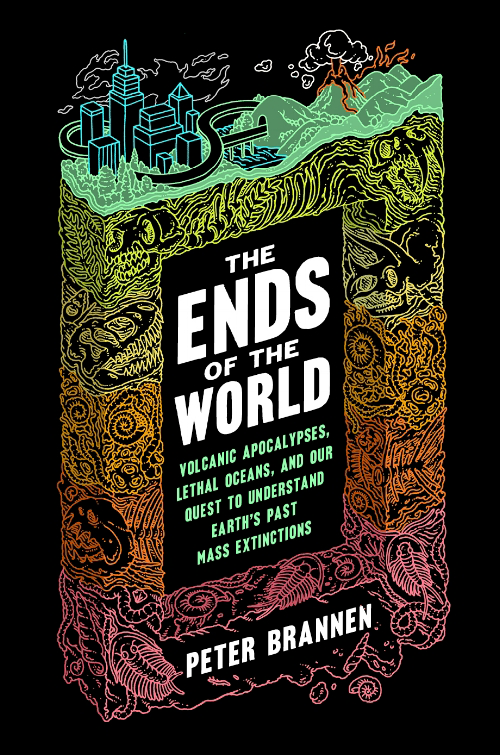
The Ends of the World by Peter Brannen, cover by Eric Nyquist
Cover by Eric Nyquist.

This new understanding of the past is extremely relevant to today because we’re pumping carbon dioxide into the atmosphere at a faster rate than those ancient lava flows. Like many, I was scared and panicked about David Wallace-Wells’ article on the worst-case scenario for climate change in New York Magazine. One aspect to many of the projections he collects in the post is that most of them stop, somewhat arbitrarily, at the year 2100. But as Peter Brannen and other science writers (such as Curt Stager in Deep Future, which I discussed in this post) warn us, our actions now will not only affect the next century but millennia to come. That’s why the perspective of deep time is so important to the discussion of climate change and yet simultaneously makes it too abstract for it to become a pressing policy issue for the majority. Maybe some immediate animal fear of being baked from the inside, or losing cognitive function from too much CO2, like Wallace-Wells caused in me, can spur us into action.

One positive fact that I got from Brannen’s book is that, despite many claims to the contrary, we are not (yet) in the midst of the sixth mass extinction in Earth’s history. Even if you add in all the megafauna extinctions, such as the loss of the charismatic giant ground sloths who ate avocados and dug out elaborate tunnel systems in South America, the world has lost only 1% of its species since we evolved. In the five mass extinctions in Earth’s history, the world lost over 75% of its species. There’s still time for us to implement sensible climate change mitigation policies and preserve our world, civilization, and culture for the centuries to come.

If you’re like me and need a chaser of hope for a shot of doom, read this post by futurist Alex Steffen on how climate action is imminent and check out this chat on Vox about Drawdown, Paul Hawken’s project to explore practical climate change solutions that use existing tech.

February 21, 2017

Yarn-Ball Future Earth

Filed under: SF Reviews — Tags: , — Will Cardini @ 8:01 am

I decided to continue my journey in the Dying Earth sub-genre by following up As the Curtain Falls by Robert Chilson with Earth in Twilight by Doris Piserchia. Compared to the other two Piserchia books I’ve read, Spaceling and Doomtime, Earth in Twilight is pretty straightforward.

The protagonist, Ferrer, travels from the planet Laredo to Earth. It’s far in the future. Earth has been overrun by an enormous jungle. The vast forest is punctured by tall space elevators that are connected by bridges and thick threads of spider web extruded by elephant-sized insects. All the human-built structures are in disrepair. I’ll let Piserchia’s own words from the first page describe her vision:

Earth looked like a big ball of yarn with a great many knitting needles sticking out of it. Loose yarn seemed to be strung from needle to needle, some of the strands so loose they nearly touched the land while others were so tight they were many thousands of miles up in the sky. Creatures great and greater made their nests on the bridges…

Everyone on Laredo thinks that humanity vacated the Earth and left it to nature centuries ago.

The setting is very similar to Hothouse by Brian Aldiss. Unfortunately I’ve only read the abridged version of that novel, published in the US as The Long Afternoon of Earth. The Earth has become tidally locked with the sun, only showing it one side which is covered in a giant banyan tree. I liked the abridged version but I want to read the full novel.

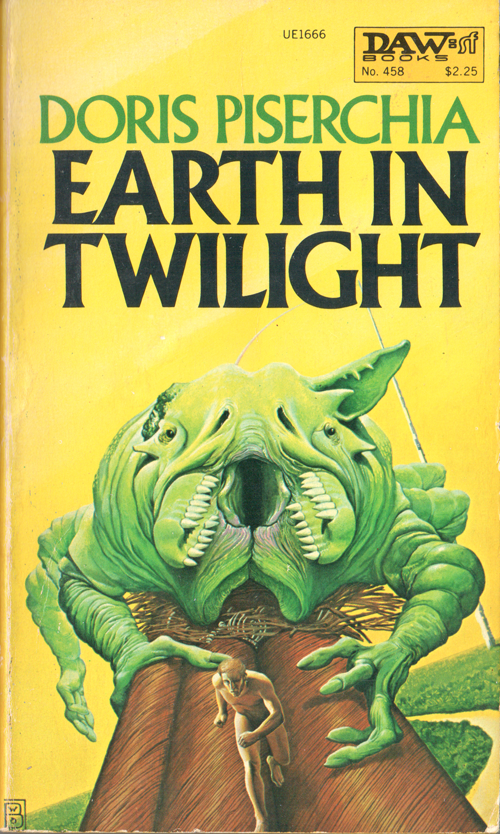
Earth in Twilight by Doris Piserchia, cover by Wayne Barlowe
Earth in Twilight by Doris Piserchia, cover by Wayne Barlowe.

In Earth in Twilight, Ferrer’s mission is to prepare the way for spaceships from Laredo that will spray the Earth with a chemical called Deep Green that will defoliate it (an ironic name in reference to the defoliant chemical Agent Orange from the Vietnam war) and make it ready for humans to repopulate. But Ferrer discovers people, strange human-plant hybrids who disgust and then charm him.

Because this book was written by Piserchia, the prose is slightly stream of consciousness and there’s lots of weird monsters, inexplicable events, and mind mergers. I won’t spoil it but the first chapter has a great twist that sets the theme for the whole book. Piserchia explores what it means to be human while showing us another one of her weird, vital visions of the future.

February 14, 2017

Space is the Place by Sun Ra

Filed under: SF Reviews — Tags: — Will Cardini @ 9:40 am

This month I’ve been ripping all my Sun Ra CDs onto my computer, correcting the metadata, splitting the LPs that were combined onto one CD, and adding missing album artwork. One of the first Sun Ra CDs I ever bought was the album Space is the Place (which is different from the soundtrack for the movie Space is the Place).


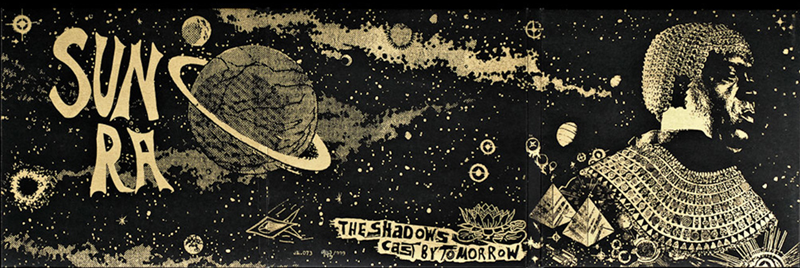
Screenprint cover by House of Traps for the three 7″ record set The Shadows Cast by Tomorrow by Sun Ra, put out on Jazzman Records.

The first track is one long 21 minute session of the Arkestra playing “Space is the Place.” There is a solid loop of horn playing and June Tyson’s singing that keeps the rhythm going while the other instruments go off on their own journeys. One of my favorite details is when Sun Ra produces the sound effect of someone being beamed up by a UFO on his space organ. Listening to this song is a spiritual experience for me. I was in tears after hearing it for the first time in many years.

Jazz in Silhouette by Sun Ra & His Arkestra
Cover for the CD Jazz in Silhouette by Sun Ra & His Arkestra, a reissue put out on the Impulse! label. Photo by Jim McCrary. Jazz in Silhouette is one of Sun Ra’s most critically acclaimed albums but I only listened to for the first time recently.

Sun Ra believed he had visited Saturn by way of astral projection. Space is a place, a state of the mind, that can be reached without technology. In this place of pure bliss, of enlightenment, there are no worries or limits. You can finally be free.

February 7, 2017

As the Curtain Falls by Robert Chilson

Filed under: SF Reviews — Tags: , , — Will Cardini @ 8:17 am

Every time my family visits our relatives in Riverside, CA, we stop at Renaissance Books. They have a great selection of old SF. This past trip I picked up a random DAW paperback with an intriguing cover and blurb, As the Curtain Falls by Robert Chilson.

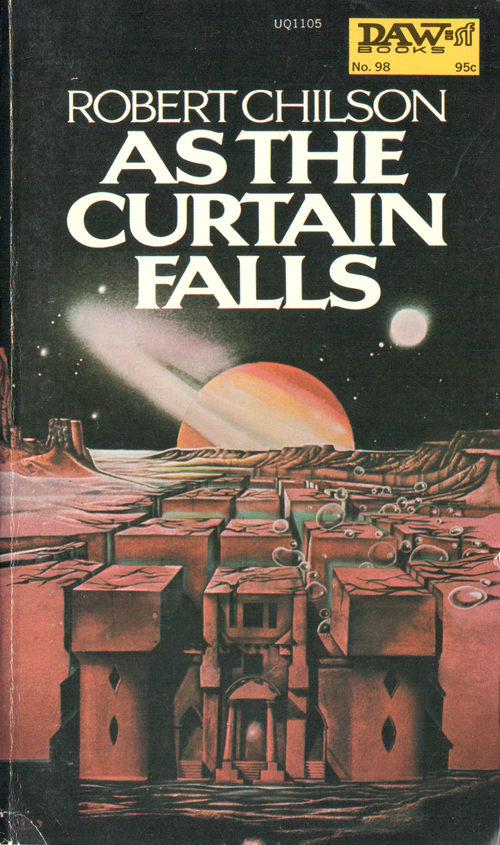
As the Curtain Falls by Robert Chilson
As the Curtain Falls by Robert Chilson, cover art by Hans Ulrich and Ute Osterwalder.

In this short novel, Chilson explores a doomed civilization that haunts ruins of technological wonder in the far future, long after humanity has explored the stars, given up on that dream, and now struggles to survive on a dying, resource-depleted Earth.

As the Curtain Falls was published in 1974, a couple years after two of the greatest books in the dying earth sub-genre: An Alien Heat by Michael Moorcock (the first part of The Dancers at the End of Time trilogy which I reviewed on this blog) and The Pastel City by M John Harrison. I see the influence of both Moorcock and Harrison on Chilson’s book, Moorcock in the sardonic attitude of the anti-hero Trebor, and Harrison in the imagery and language. On the whole, As the Curtain Falls might not reach the heights of those two books, but Chilson does outdo them both in his evocative setting: the oceans have dried out and the continents are uninhabitable; the remnants of humanity live in the ocean bottoms, the amount of arable land shrinking each generation as the salted deserts encroach.

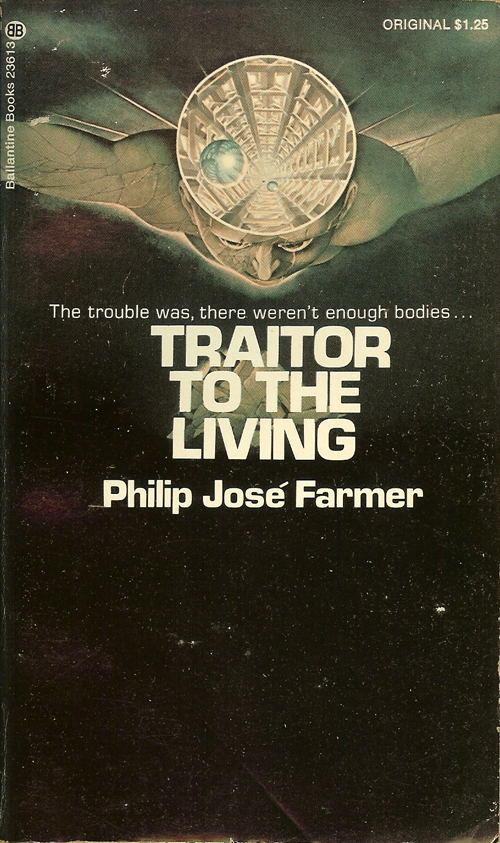
Traitor to the Living by Philip Jose Farmer
Traitor to the Living by Philip José Farmer, another cover by Hans Ulrich and Ute Osterwalder.

Chilson has done extensive world-building for this future that he only uses in this one 174-page book. The forests are phosphorescent trees and colorful coral. Starfish and lobsters are the predators. People move across the salt flats in giant sleds with sails. Insects and bacteria have evolved to eat plastic. Gems are polished chunks of a mysterious substance manufactured by the lost civilizations of the Dawn. We get glimpses of a long history of empires and conflicts without dwelling too much on specifics. This long history has thematic resonance – We feel the weight of this history, the hundreds of millions of years of humanity that has lead to this moment near the end, the vast impersonal hate of time. This theme is common to the best books of the dying Earth sub-genre.

Another aspect of this book that I really enjoyed is the focus on art. Many SF books are so focused on technology that they devalue or ignore the non-functional products of civilization. But the title of As the Curtain Falls is probably a reference to the curtain falling over the play of humanity on the Earth. And there’s a complete play within the novel that is cut from an inexplicable theatrical tradition with no explanation of its meaning by the narrator. Finally there’s the eccentric immortal that our protagonists meet while they’re running through the giant midden heaps of the Dawn age, an immortal who proclaims to them that “art is longer than any life.” The endurance of art is the only weak hope that Chilson offers us.

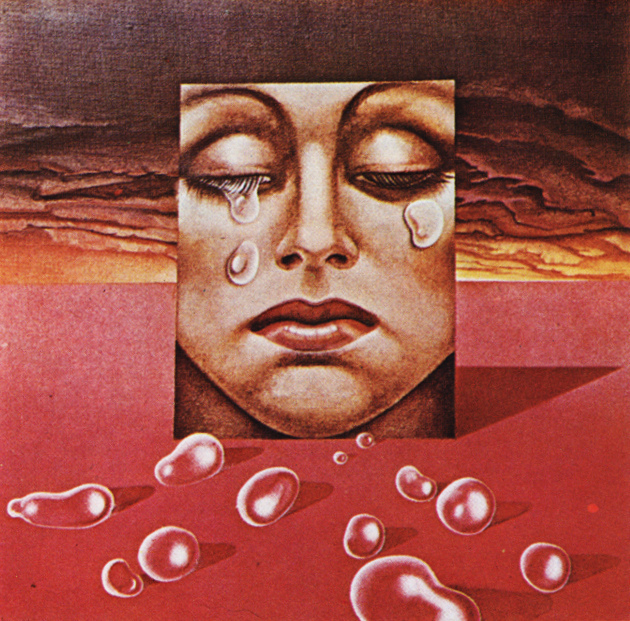
Painting by Hans Ulrich and Ute Osterwalder for the cover of Flow my Tears the Policeman Said by Philip K Dick
A painting by Hans Ulrich and Ute Osterwalder for the cover of Flow my Tears the Policeman Said by Philip K Dick.

I hadn’t heard of Chilson before I bought As the Curtain Falls on a whim. He hasn’t written much but I’m going to look for his other original novels.

January 31, 2017

Tom Grindberg’s Thick Lined, Bulky Superheroes in 1993 and 1994

Filed under: Comics Criticism — Tags: , — Will Cardini @ 9:41 am

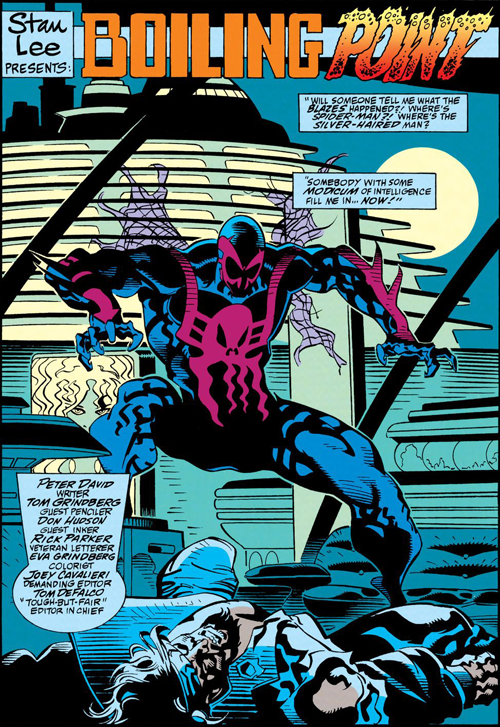
In 1993 when I was a kid, Tom Grindberg was a guest penciler for two issues of my favorite Marvel superhero series: Silver Surfer #84 and Spider-Man 2099 #14. I hated his artwork then because it was such a radical departure from the thin lines of Ron Lim and Rick Leonardi.

Spider-Man 2099 #14 by Tom Grindberg
A splash page from Spider-Man #2099 #14. Artwork by Tom Grindberg, penciler; Don Hudson, inker; Eva Grindberg, colorist; and Rick Parker, letterer.

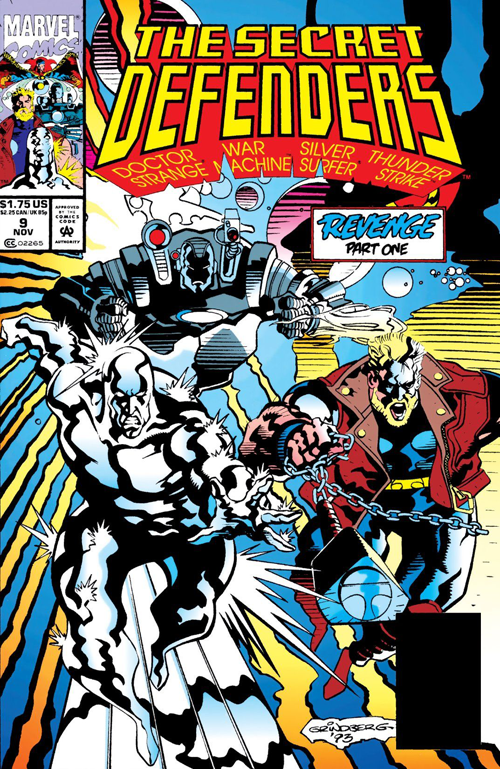
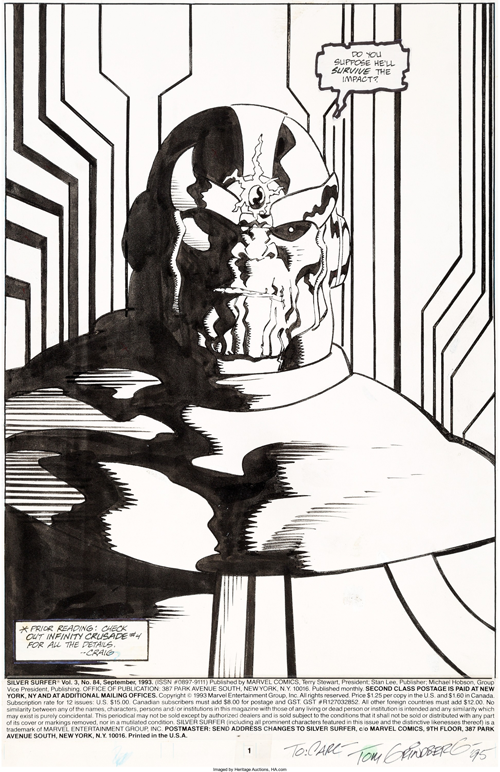
But now I love it! It’s amazingly ugly. His figures are impossibly bulky and stretch in weird, fluid ways. They just seem so big and imposing and in your face which is great for bruisers like Thanos, Thor, and Drax.

Secret Defenders #9 cover pencils by Tom Grindberg
The cover of Secret Defenders #9. Artwork by Tom Grindberg, penciler; Don Hudson, inker; John Kalisz, colorist; and John Costanza, letterer.

It looks weird for someone who’s usually more svelte like the Silver Surfer, Spider-Man, Dr Strange, or Adam Warlock, but I like weird.

Silver Surfer #84 original artwork by Tom Grindberg
The original art for a splash page from Silver Surfer #84. Artwork by Tom Grindberg, penciler; Tom Christopher, inker; and Ken Bruzenak, letterer.

Overall his renditions of characters look more alive than the stiff figures of more popular artists like Lim and Rob Liefeld. The thick, wavy black lines are out of this world. But what’s strange is that, as far as I can tell, Grindberg only drew this way in 1993 and the first half of 1994. By his next issues of Silver Surfer and Spider-Man 2099, #93 and #25 respectively, he’s much closer to early 90’s Marvel house style. And it didn’t matter whom his inker was – Don Hudson inked Spider-Man 2099 #14, Secret Defenders #9, and Grindberg’s short story in Spider-Man 2099 #25. Someone must have told him to rein it in, which is a bummer.

January 17, 2017

Brackish by Katie Mulholland and Sarah Welch

Filed under: Comics Criticism — Tags: , — Will Cardini @ 9:02 am

I miss Texas. I’ve lived in the Kansas City metro area for almost two years now and I still miss Texas. Strangely I sometimes miss Houston more than Austin, even though I’ve lived in Austin for the majority of 13 years and lived in a suburb of Houston, never the city itself, before that. But growing up in that boring suburb, Houston meant culture and excitement to me as a teen. I drove down there as often as I could, hanging out in coffee shops and wandering through museums. Houston has some really great museums. I’ve spent a lot of time in front Yves Tanguy, Cy Twombly, and Philip Guston paintings.

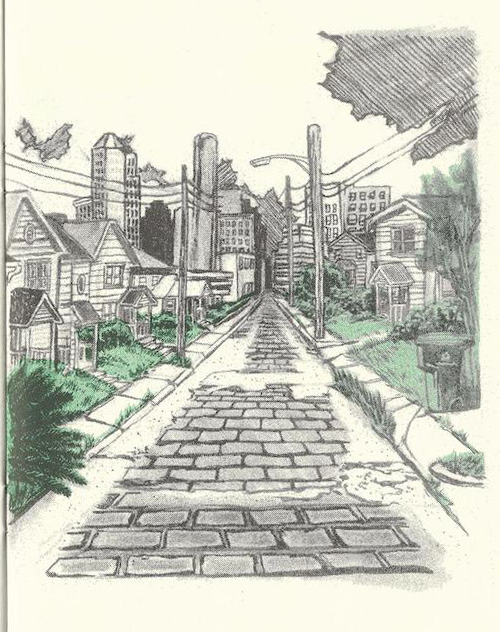
So when Robert Boyd mentioned this zine Brackish, a collection of great drawings by Sarah Welch and Katie Mulholland, in his write up of Houston Zine Fest 2016, I had to get it. These atmospheric drawings of a transforming Houston make me nostalgic. Here’s one example:

Sarah Welch drawing from Brackish
Brackish page 28, drawing by Sarah Welch.

Sarah Welch’s drawing really transports me. I’ve walked down a residential street like that with the Houston skyline in the background many times. Houston is a swamp but it’s my swamp. The lack of zoning laws makes for some interesting architectural juxtapositions.

January 10, 2017

Earthseed by Octavia Butler

Filed under: SF Reviews — Tags: , , — Will Cardini @ 9:20 am

Octavia Butler’s Earthseed series is two beautifully written, brutal but sometimes hopeful and emotionally devastating epistolary novels, Parable of the Sower and Parable of the Talents, that came out in the 1990’s.

Butler has been on my to-read list for a while. I started with these two novels that are some of the last that she wrote because I heard that in the second novel, America elects a fascist President whose campaign slogan is “make America great again.” Very relevant to our recent election.

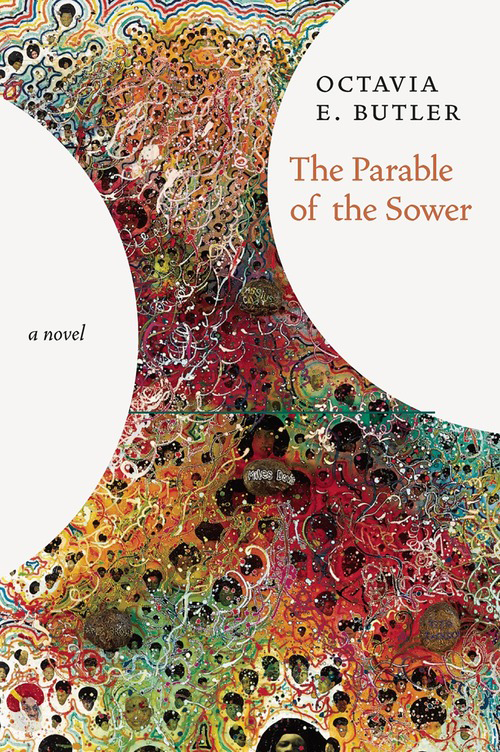
Cover for a new hardcover edition of Parable of the Sower by Octavia Butler
Cover for a new hardcover edition of Parable of the Sower coming out in February from Seven Stories Press. I couldn’t find the cover artist on their website.

Parable of the Sower is terrifying because it’s very plausible. Butler portrays a future America that has been devastated by an economic collapse caused by climate change. No one but the ultra rich can afford gas for vehicles. Food is expensive so middle class communities grow their own in gardens and learn how to eat foods like acorns. Many people are homeless migrants walking long roads to escape extreme drought further south. Everyone is so desperate to survive and there is so much crime that no one can afford to be kind. I don’t read a lot of post-apocalyptic SF so I found the breakdown of the social order to be frightening, but if you read a lot of those books this may not affect you as much.

The book is a sequence of diary entries and religious verses by the main character, Lauren Oya Olamina. This format adds to the realism. At first Olamina is introducing you to her walled neighborhood, a somewhat familiar place of relative stability in the chaos. But then she is forced to make a harrowing journey, walking north on California’s highways, surrounded by violent vagrants and fleeing before walls of fire set by drug addicts who experience orgasmic pleasure when they watch flames burn.

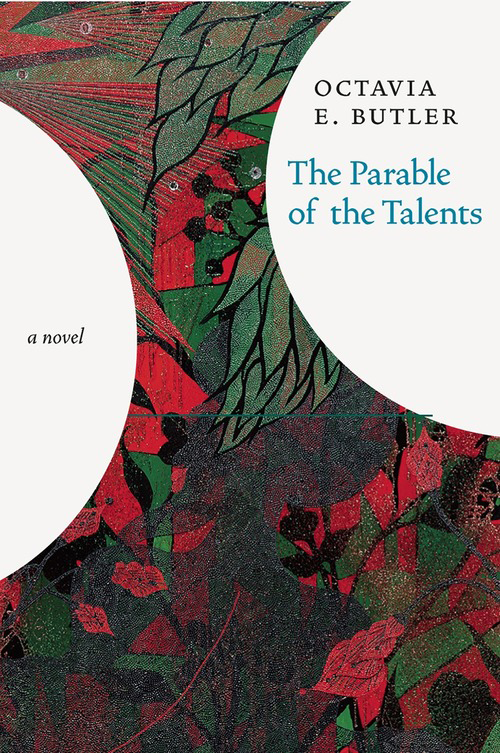
Cover for a new hardcover edition of Parable of the Talents by Octavia Butler
Cover for a new hardcover edition of Parable of the Talents coming out in February from Seven Stories Press. I couldn’t find the cover artist on their website.

Parable of the Talents is set five years after the end of Parable of the Sower. At first, the sequel feels less alarming, perhaps because Butler adds introductory texts by other characters to Olamina’s diary entries. Until the halfway point – then a major change in Olamina’s circumstances upset me so much I could barely read it.

There are some spoilers and mention of sexual assault and slavery in the paragraph ahead. Click through to read the rest of the review.

June 1, 2016

Cosmic Consciousness and Climate Change in SF

At its best, SF grapples with big ideas such as humanity’s place in the cosmos and our role as reshapers of landscapes, ecosystems, the climate, and potentially other worlds. As our culture changes, the stories we tell ourselves about ourselves also changes. I’m a cartoonist, an artist and a storyteller. I have to believe that our stories matter and can shape how we behave–otherwise what’s the point in creating them? They’re mirrors we hold up to ourselves. Or perhaps a scrying glass, trying to catch a glimpse of our possibilities.

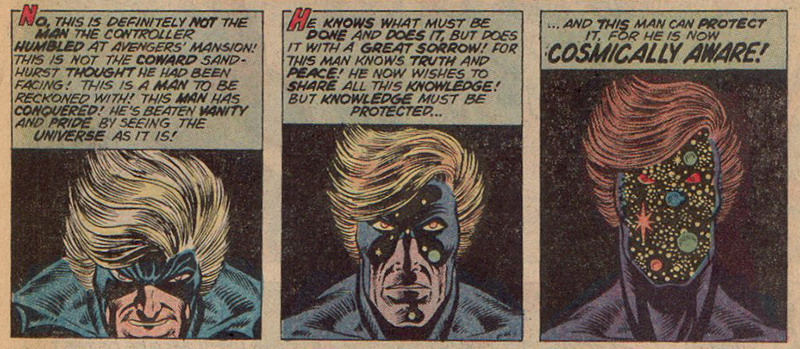
He is now cosmically aware!
Panels from Captain Marvel #30, written and pencilled by Jim Starlin, inked by Al Milgrom, and lettered by Tom Orzechowski.

Click through for an essay discussing This Changes Everything: Capitalism vs the Climate by Naomi Klein, Deep Future: The Next 100,000 Years of Life on Earth by Curt Stager, Last and First Men by Olaf Stapledon, Fury by Henry Kuttner, 2312 by Kim Stanley Robinson, and more.